
If you’re shopping for a wall-mounted or recessed electric heater, you want quick warmth, easy control, and reliable safety features. This guide highlights five well-suited options for American homes, covering compact units for small spaces, smart heaters for bedrooms and living rooms, and energy-conscious models for ongoing comfort. Each pick is described with who it’s best for, why it stands out, and a practical caveat to consider before you buy.
Product Comparison At A Glance
| Product | Best For | Why It Stands Out | Notes |
|---|---|---|---|
| Cadet Com-Pak CSC151TW | Smaller rooms or bathrooms | Compact unit with built-in thermostat for straightforward control | 5120 BTU, 1500W, 120V |
| Cadet Com-Pak CSC202TW | Small living areas with flexible wiring | Two voltage options with higher BTU, ceiling installation possible | 6825/5120 BTU, 2000/1500W, 240/208V |
| Dreo WH719S | Smart control and fast room heating | Wide oscillation, remote/app/voice control, precise temp | 1500W, 120° oscillation |
| DREO IP24 Wall Heater | Quiet, office or bedroom heating | Quiet operation with 30° manual oscillation and smart control | PTC, 11.5 ft/s airflow, 28 dB |
| faasiu CSC101TW | Budget-friendly basic heat in small zones | Efficient 1000W with built-in thermostat and safety protections | 1000W, 120V |
Cadet Com-Pak CSC151TW Electric Wall Heater

Best for compact spaces, this Cadet unit delivers 5120 BTU from a standard 120-volt circuit. The built-in thermostat provides straightforward temperature management, making it a solid choice for small bedrooms, bathrooms, or utility rooms where space is at a premium. The model’s simplicity supports quick installation and predictable warmth. A potential limitation is its smaller heating output, which may be insufficient for larger living rooms or spaces with poor insulation.
Cadet Com-Pak CSC202TW Electric Wall Heater
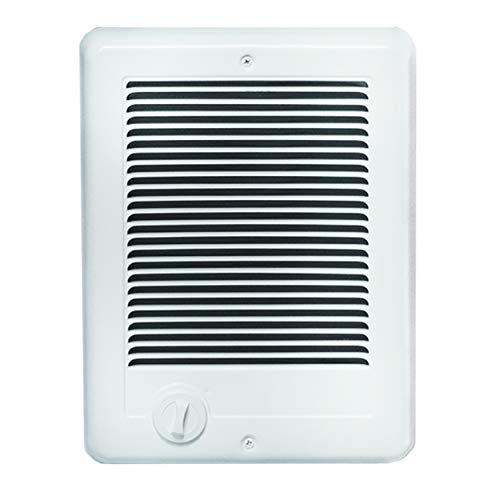
Better for small living areas that might benefit from higher BTU options and installation flexibility, this unit supports 240/208-volt wiring with 2000/1500 watts, helping it heat spaces up to roughly 200 sq. ft. The model’s fast-heating coil element is a key advantage for quicker comfort. A caveat is that higher voltage requirements may necessitate a professional electrical assessment or dedicated circuit wiring.
Dreo WH719S Smart Wall Heater

Ideal for rooms where smart control matters, this heater offers 1500W of power and 120° oscillation for broad coverage. It supports scheduling via app and voice control through Alexa or Google Home, plus a precise, adjustable thermostat range. The device is well-suited for bedrooms and living rooms where you want the thermostat to align with daily routines. A consideration is that sphere-wide motion and electronic controls may require a stable Wi-Fi connection for ongoing use.
DREO IP24 Smart Wall Heater

Best for quiet, office-like spaces, this model emphasizes a low-noise profile with 30° manual oscillation for targeted warmth. The IP24 rating suggests resistance to moisture-prone environments, which is helpful in damp rooms or bathrooms with proper installation. It includes remote control or app-based options and works with voice assistants. A limitation is that precise temperature calibration features rely on app use, which may be less convenient in areas with spotty connectivity.
faasiu Electric Wall Heater With Thermostat

Best for budget-conscious buyers needing quick, reliable heat in small zones, this unit offers 1000 watts on a standard 120V circuit. It includes an integrated thermostat and safety features designed to prevent overheating. The simpler interface makes it easy to install and operate. The trade-off is lower max output, so consider larger or drafty spaces where more BTU may be needed.
Buying Guide: Key Considerations When Choosing Wall Heaters
- Space and BTU needs: Measure the room and compare the unit’s BTU rating to the space. Higher BTU models heat larger areas, but may use more power.
- Voltage and wiring: Some models use 120V, while others require 208/240V. Check your electrical panel and consult an electrician if needed.
- Installation type: Wall insert vs. surface-mount, and whether ceiling or recessed installation is an option for your room layout.
- Control options: Built-in thermostats are simple; smart features (app control, voice assistants) offer convenience but rely on connectivity.
- Noise and airflow: Consider models with quiet operation for bedrooms or offices. Oscillation helps distribute heat evenly.
- Safety features: Look for automatic shutoff on overheating, cool-touch surfaces, and safe wall mounting to prevent hazards.
- Energy efficiency: ECO modes and precise thermostats help minimize energy use while maintaining comfort.
When to Choose Which Type
- Small spaces or bathrooms: Compact units with reliable thermostats, like Cadet CSC151TW, are often best.
- Flexible voltage and higher heat needs: The Cadet CSC202TW provides options that support larger or variably wired spaces.
- Smart control values: Dreo WH719S is ideal if you value scheduling, voice control, and app access for frequent adjustments.
- Quiet office or bedroom heating: DREO IP24 offers silent operation with targeted control features.
- Budget-friendly quick heat: faasiu CSC101TW balances price with essential heating and safety features for smaller zones.
FAQ
- Q: Do wall heaters require professional installation? A: Some models are simple plug-in units, while others may require mounting and wiring by a licensed electrician.
- Q: How many watts should I choose for a room? A: For small rooms, 1000–1500W often suffices; larger rooms may need 2000W or more with appropriate wiring.
- Q: Are smart features worth it? A: If you value precise scheduling and remote control, smart models offer convenience and potential energy savings.
- Q: Can I install these in a bathroom? A: Some models are rated for use in damp or moisture-prone areas, but always verify the IP rating and installation guidelines.
- Q: How do I ensure even heat distribution? A: Look for models with fan-assisted or oscillating designs to spread warmth across the room.
- Q: What about safety protections? A: Prioritize models with automatic shutoff, overheat protection, and cool-touch surfaces for safer operation.