
In this guide
If you need compact, gas-powered instant hot water, these slim tankless models deliver reliable on‑demand heat without bulk. This guide highlights five small-footprint options ideal for apartments, narrow utility spaces, or whole‑house use. They’re chosen for efficiency, space savings, and consistent temperatures across multiple fixtures. The buyer’s intent is to find a compact, gas-fired solution that can supply hot water for several points of use without a bulky storage tank. Below is a quick comparison of five suitable models to help you decide which fits your home best.
| Product | Max Flow | BTU | Best For |
|---|---|---|---|
| ThermoMate CZ422NG | Up to 5 GPM | 113,000 BTU | Busy households needing two showers simultaneously |
| CAMPLUX Climatech 7 | Up to 6 GPM | 132,000 BTU | Families with multiple fixtures and quiet operation |
| RANEIN Natural Gas Tankless | Up to 4.3 GPM | 100,000 BTU | Compact spaces with 2–3 fixtures |
| Konfino Indoor Natural Gas Tankless | Up to 4.3 GPM | 102,000 BTU | Space-saving unit for 3–4 points of use |
| MIZUDO Natural Gas Tankless | Up to 10.3 GPM | 199,000 BTU | Large households needing high flow across many fixtures |
ThermoMate CZ422NG Natural Gas Tankless Water Heater

Max 5 GPM and 113,000 BTU power this indoor unit for whole-house hot water with rapid response. The smart flow sensor and control chip adjust heating up to 20,000 cycles per second, delivering stable temperatures within ±1°F. Four ceramic heating cores and frost protection enhance reliability in cold climates.
Best for: households needing two showers running at once with precise temperature control. This model is ideal for busy homes where hot water must be instantly available in multiple fixtures.
Why selected: high efficiency (98% heat exchanger) and a strong balance of GPM, BTU, and temperature stability for small-to-medium homes.
Caution: ensure proper venting and clearance in tight indoor spaces to maintain safe operation and adequate combustion air.
CAMPLUX Climatech 7 Tankless Water Heater

This indoor gas tankless unit delivers up to 6 GPM with 132,000 BTU and AI-powered 95% efficiency. It features AI Anti-Shock and ±0.5°C control for stable temperatures during use, plus a bottom-fan design that keeps noise at about 45 dB—much quieter than many competitors.
Best for: households that value ultra-stable temperature and quiet operation across multiple fixtures, with strong performance in compact spaces.
Why selected: high max flow for a slim unit and modern control system that reduces temperature drift during varying demands.
Caution: the unit’s efficiency claims depend on proper venting and installation clearances; improper setup can reduce performance.
VELPAX Propane Tankless Water Heater

Rated at 4.21 GPM with 68,000 BTU, this propane unit uses a stainless steel body and oxygen-free copper for efficient heat transfer. An LED smart display enables easy temperature adjustments from 95°F to 149°F, supporting simultaneous use in bathrooms and kitchens.
Best for: compact spaces needing straightforward, on-demand propane hot water with simple digital control.
Why selected: durable construction and clear temperature control make it a practical pick for smaller homes or apartments with propane access.
Caution: suitable only for propane; ensure fuel supply and ventilation meet local codes.
ORBEK Natural Gas Tankless Water Heater
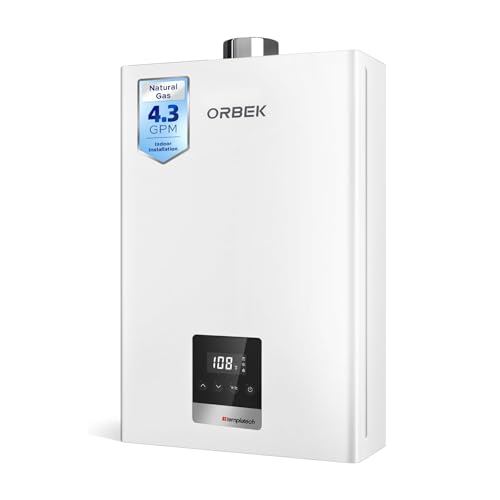
Providing up to 4.3 GPM and 100,000 BTU, ORBEK supports 2–3 fixtures with a compact design. It features a smart temperature control that maintains ±1°F and performs well under low water pressure, starting at 0.53 GPM.
Best for: small homes or apartments that need dependable hot water across multiple fixtures without storage tanks.
Why selected: reliable temperature stability with low-flow performance helps prevent cold-water shocks when fixtures draw water simultaneously.
Caution: limited to around 4.3 GPM; consider higher-GPM models if your household frequently runs several fixtures at once.
Konfino Indoor Natural Gas Tankless Water Heater

This unit offers up to 4.3 GPM with 102,000 BTU and smart digital display. It supports 3–4 points of use and utilizes stainless steel and oxygen-free copper components for durability and efficient heat transfer.
Best for: households needing a space-saving solution that still can run showers and a dishwasher simultaneously.
Why selected: balanced GPM, robust protective features, and a compact wall-mount design suitable for tight interiors.
Caution: ensure adequate ventilation and clearance to maintain safe operation in smaller rooms.
Buying Guide: Slim Gas Tankless Water Heaters
- Size and footprint: Look for wall-mounted models with slim profiles designed for apartments or utility closets. Measure available wall space and check the installation clearance recommendations.
- Flow vs. BTU balance: Higher GPM means more simultaneous outlets; BTU indicates peak heating capacity. Choose a unit whose GPM meets your peak simultaneous usage while staying within your climate and pipe sizes.
- Temperature stability: Temperature drift can cause uncomfortable showers. Models with ±1°F to ±0.5°C stability perform best under fluctuating demand.
- Energy efficiency: Heat exchanger material (oxygen-free copper vs. stainless) and overall efficiency affect operating costs. Copper exchangers often offer better thermal conductivity and longevity.
- Ventilation and gas type: Confirm whether the unit is designed for natural gas or propane and ensure proper venting and venting clearances in your space.
- Safety features: Look for protections like flame-out, freeze protection, anti-dry firing, and automatic shutdown in case of faults or low water pressure.
- Installation considerations: Some models require professional installation to ensure proper gas line, venting, and electrical connections are up to code.
FAQ
- What does GPM mean in tankless water heaters? GPM stands for gallons per minute and indicates the maximum hot water flow the unit can supply at a given temperature rise.
- Do slim gas tankless heaters require venting? Yes. Most indoor gas tankless models require venting to exhaust combustion gases and intake fresh air.
- Can these heaters supply hot water to multiple fixtures at once? Yes, up to the unit’s rated GPM. Larger households may need higher-GPM models or a system designed for multi-point use.
- Are copper heat exchangers better than stainless steel? Copper exchangers typically offer superior thermal conductivity and corrosion resistance, contributing to efficiency and longevity.
- Is professional installation required? In most cases, yes. A licensed plumber or gas technician can ensure safe gas connections, venting, and compliance with local codes.
- How do I choose between natural gas and propane models? Choose based on your available fuel source and local gas supply lines. Propane units are common for off-grid or retrofit scenarios where natural gas isn’t accessible.