
In this guide
If you’re outfitting an RV for winter travel, basement or underbelly heating can protect pipes, tanks, and cargo bays from freezing while keeping living areas comfortable. The following five products are among the most relevant options for RV basements, engine compartments, and auxiliary spaces. They cover wall-mounted infrared, portable heaters, compact furnace units, and smart-control models for easy remote operation.
| Product | Brand | Key Use | Estimated heating focus |
|---|---|---|---|
| Heat Storm HS-1500-PHX-WIFI Infrared Heater | Heat Storm | Wall-mounted, basement or storage spaces | Infrared warmth with Wi‑Fi control |
| Dr Infrared Heater Portable Space Heater | DR. INFRARED HEATER | Portable basements or cabins | Infrared + PTC heating |
| FOGATTI RV Furnace 35,000 BTU | FOGATTI | Complete RV furnace for basements and living areas | High-output space heating |
| GiveBest Smart Wall Heater | GiveBest | Smart-controlled wall heater for tight spaces | WiFi/app/Alexa control |
| Ranein 2025 GEN II On-Demand 65,000 BTU RV Tankless Water Heater | Ranein | RV heating of water and auxiliary heat | High-capacity hot water with high-altitude support |
Heat Storm HS-1500-PHX-WIFI Infrared Heater, Wifi Wall Mounted

The Heat Storm HS-1500-PHX-WIFI is designed for wall installation, saving floor space in smaller RV basements or storage compartments. Its Wi-Fi capability allows temperature control from a phone, which can be useful when you’re not near the unit. A built-in touch screen with a digital thermostat simplifies local adjustments, while a remote is included for convenience. A safety tip-over switch protects against accidental angle changes, and the unit is optimized for compact spaces where standing heaters would clutter floor area. Ideal for bedrooms, kitchens, and compact storage bays within an RV.
Dr Infrared Heater Portable Space Heater

The Dr Infrared Heater delivers rapid warmth in RV basements and smaller living spaces with its dual heating system: infrared quartz tubes plus PTC for efficient heat output. It’s designed to heat large rooms and includes auto energy-saving features plus a 12-hour timer. With tip-over and overheat protection, it’s a safe choice for enclosed areas. The unit operates with a relatively quiet blower at about 39 dB, and its infrared technology targets objects and people directly, providing steady warmth without heating unused space excessively.
FOGATTI RV Furnace 35,000 BTU Complete Unit
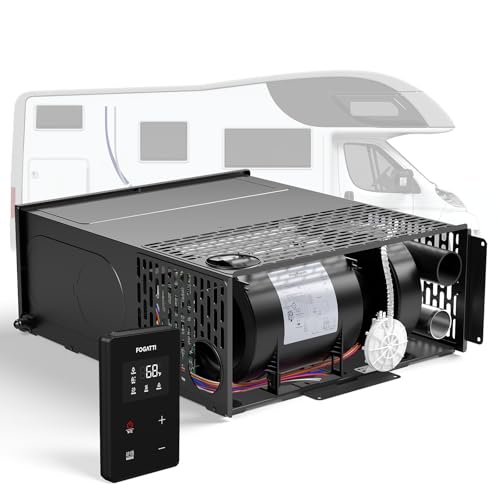
This complete RV furnace unit from FOGATTI offers 35,000 BTU with multiple heat levels and 260 CFM airflow for rapid heating across a camper, motorhome, or trailer basement area. It comes as a full kit with motor, chamber, housing, and thermostat, eliminating the need to source individual components. The system supports three modes—quick heat, standard, and sleep—and includes fault monitoring for straightforward troubleshooting. Its compact design helps maximize space while delivering reliable warmth in cold storage bays or basements of RVs.
GiveBest Smart Wall Heater

The GiveBest Smart Wall Heater combines a 1500-watt heating element with smart controls for flexible basement or under-cabinet heating in an RV. It supports Wi-Fi connectivity, a dedicated mobile app, and voice control via Alexa, enabling remote scheduling and temperature adjustments. Its design supports wall mounting or standing on a base to fit different installation preferences. The unit offers three heating modes and a 24-hour timer, balancing energy use with consistent warmth for small-to-medium basement compartments in an RV.
Ranein 65,000 BTU RV Tankless Water Heater

The Ranein GEN II on-demand water heater offers 65,000 BTU for rapid hot water delivery, suitable for RV basements where maintaining water supply is essential. It operates at 12V and is CSA approved, which helps ensure safety in mobile installations. The unit supports high-altitude operation and features a multi-function remote control showing real-time gas usage, voltage, water flow, anti-freeze status, and altitude support up to 9,800 feet. Adjustable output and efficient heating help keep plumbing bays warm and prevent freezing risks during extended storage or trips.
Buying Guide: Key Considerations When Choosing an RV Basement Heater
- Heating capacity and space: Measure the basement or storage bay and compare BTU or wattage with the unit’s coverage. Small spaces require lower wattage or BTU to avoid overheating or unnecessary energy use.
- Installation flexibility: Wall-mounted units save floor space, while portable models offer versatility across different bays. Ensure proper clearance and ventilation as needed by the heat source type.
- Safety features: Look for tip-over and overheat protection, automatic shut-offs, and sealed electronics for damp environments. Gas-powered units should include proper ventilation and venting guidance.
- Smart controls and scheduling: Wi-Fi, app control, and voice assistants can simplify remote operation, especially when you’re away from the RV. Verify compatibility with your preferred ecosystems.
- Reliability in cold conditions: For occasional winter storage, consider frost protection and continuous operation modes. Some units are designed with anti-freeze alerts or frost-ready settings.
- Energy source and availability: Gas, propane, and electrical heaters have different requirements when you’re parked in varied locations. Plan for power supply limits in campgrounds or off-grid setups.
- Maintenance and replacement parts: Check for common spare parts (filters, igniters, thermostats) and ease of servicing, especially for RV-specific models.
- Compatibility with RV size and layout: Ensure the unit’s physical dimensions fit your basement or underbelly space and that ducting or venting paths won’t interfere with tanks or lines.
When selecting a heater for an RV basement, balance space constraints, energy management, and safety. The options above cover wall-mounted infrared, portable heaters, complete furnace units, and smart-controlled models, offering a range of approaches for protecting RV basements, tank bays, and other storage areas against freezing temperatures while maintaining comfort in adjacent living spaces.