
When you need reliable, space-saving hot water on demand, a point-of-use (POU) or near-pantry heater can be the right choice. This guide highlights five compact options that deliver quick hot water without a full-size tank. Each product is suited for small apartments, under-sink installations, or busy kitchen and bathroom setups where space is premium and energy efficiency matters. The list compares best-for scenarios, installation notes, and practical limits to help you choose the right unit for your home or workspace. A quick buyer summary follows to help you scan the essentials at a glance.
| Product | Best For | Key Benefit | Limitation |
|---|---|---|---|
| Rheem RTEX-06T | Single sink or compact setup | Consistent water within 1 degree of setpoint | Requires 240V circuit |
| GE Appliances 2.5 Gallon Mini Tank | Under-sink or small bath | Compact, easy installation with standard connections | Limited hot water while running multiple fixtures |
| Electric Tankless 110V 3000W | Small kitchen or bathroom sink | 3kW heat, fast warm-up | Low capacity for multiple outlets |
| ThermoMate 8kW Tankless | High-demand point-of-use | Self-modulating for energy efficiency | Requires 40A breaker and dedicated wiring |
| ThermoMate 3500W 120V | Under-sink or compact faucet lines | Low-profile, easy wiring | Inline with single faucet use |
Rheem RTEX-06T, 6.5kw Point-of-Use Tankless Electric Water Heater

The Rheem RTEX-06T delivers endless on-demand hot water with precise temperature control. This 6.5 kW unit is designed for 240V circuits and is optimized for point-of-use installation. It maintains water temperature within 1 degree of the selected setting, making it ideal for single-sink or compact bathroom setups. It is significantly smaller than traditional tank heaters, saving valuable space in tight utility areas. Best for: households needing reliable, compact, near-sink heat with minimal footprint. Caution: installation requires appropriate electrical service and a dedicated circuit; ensure compatibility with your wiring layout.
GE Appliances 2.5 Gallon Mini Tank Water Heater

GE’s mini tank offers a compact solution for places with limited space, such as under-sink installations, bathrooms, or small kitchens. It uses standard 1/2-inch NPT water connections for straightforward wall or floor mounting. This model can function as a standalone heater or as a booster inline with a larger system to extend hot water reach along long pipe runs. Best for: small apartments or cabins needing a simple, space-efficient hot water booster. Caution: capacity is limited; avoid using with multiple hot water fixtures at once.
Electric Tankless 110V 3000W Under Sink

This 110V, 3000W tankless model is designed for quick, on-demand hot water at a single sink. It features a compact form and a digital display for easy temperature monitoring. It’s best for a dedicated hot-water point in kitchens or baths that aren’t connected to a larger multi-outlet system. Best for: small kitchens or powder-room sinks needing fast hot water with a straightforward install. Caution: limited flow and temperature rise may not support multiple fixtures simultaneously.
ThermoMate 8kW Tankless Point-of-Use

The ThermoMate 8kW unit operates with self-modulating technology to adjust energy use as water flow and temperature change. With 8 kW heating, it supports up to two faucets at a time and delivers a 1.56 GPM at a 35°F rise. It’s compact, wall-mounted, and uses a 40A breaker. Best for: households needing efficient, higher-capacity point-of-use heat in tight spaces. Caution: requires dedicated 40A wiring and proper electrical planning to avoid overloads.
ThermoMate 3500W Small Electric Tankless
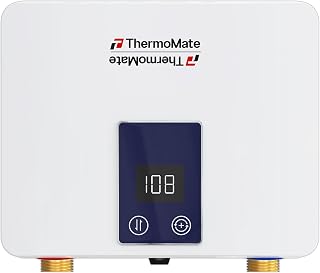
This compact 3500W, 120V heater is designed for under-sink or small faucet lines. It requires hard-wiring rather than a plug connection and uses a 0.4–0.66 GPM flow range. Temperature is adjustable between 86°F and 131°F. Best for: kitchens or baths needing a simple, under-sink supply with easy wiring. Caution: only suitable for single-outlet use; not recommended for simultaneous multiple fixtures.
Buying Guide: Key Considerations for Point-of-Use Water Heaters
What space and location should you prioritize?
Choose a unit that fits the available space and mounting options. Under-sink and wall-mounted models maximize cabinet and closet space. If you lack wall space, a compact tankless option is preferable to a bulky small-tank heater.
What flow rate and temperature rise do you need?
Consider the GPM (gallons per minute) you require at your typical faucet and the desired temperature rise. Higher kilowatts enable faster heat, but require appropriate electrical service and dedicated breakers.
Electrical requirements: do you have the right service?
Many point-of-use heaters demand a dedicated circuit and specific breaker sizes (for example, 40A for higher-capacity units). Verify your electrical panel can support the added load before installation.
Booster versus standalone?
Standalone POU heaters provide immediate hot water at a single point. Booster models enhance hot water along long pipe runs when used with a primary heater. Decide which approach aligns with your home’s plumbing layout.
Durability and maintenance expectations
Look for corrosion-resistant materials, reliable temperature control, and easy access for service. Units with self-modulating technology typically save energy by matching heat output to demand.
Safety features and installation considerations
Water resistance, dry-fire protection, and leak safeguards are essential. Ensure professional installation if required by local codes, especially for high-power units.
Frequently Asked Questions
- What is a point-of-use water heater? A compact unit installed near a sink or shower that provides hot water on demand without a storage tank.
- Do I need electrical work to install one? Yes. Most models require a dedicated circuit and proper breaker sizing. Consult a licensed electrician for safe installation.
- How much space will a POU heater occupy? Most units fit under sinks or on small wall spaces, with dimensions designed for tight installations.
- Can a POU heater supply hot water to more than one faucet? Some models support two fixtures, but many are best for a single outlet or booster role. Check the product’s specified GPM rating.
- Is a tankless POU heater better than a traditional small-tank heater? Tankless options save space and can reduce standby energy losses, but capacity and flow limits may affect performance with multiple outlets.
- What maintenance is required? Regular inspection of connections, mineral buildup prevention, and following the manufacturer’s service recommendations help maintain efficiency.