
In garages and workshops, overhead propane radiant heaters provide reliable warmth without relying on electricity. This guide highlights five top options, explains who each is best for, and helps you compare features like BTU output, room size, ignition, and safety protections. Use these picks to choose a heater that fits your space, power access, and safety needs.
Summary table of chosen products
| Product | BTU | Best For | |
|---|---|---|---|
| Mr. Heater MH40LP | 40,000 | Large garages and workshops needing quick, strong heat | Gas-powered, no electricity required |
| Mr. Heater 30,000 BTU Vent Free Radiant Propane Heater | 30,000 | Medium garages and sheds | Vent-free, electronic ignition |
| Mr. Heater 30,000 BTU Vent Free Radiant Natural Gas Heater | 30,000 | Natural gas setups | Vent-free, electronic ignition |
| OKF Propane Heater, 6k–18k BTU | 6,000–18,000 | Smaller spaces and indoor use | 3 modes, safety protections |
| Mr. Heater 18,000 BTU Vent Free Radiant Propane Heater | 18,000 | Smaller to mid-size spaces | Vent-free, electronic ignition |
Mr. Heater MH40LP 40,000 BTU Propane Garage Heater

The MH40LP is designed for large spaces that require significant warm-up power. Best for open garages or workshops that lack electrical heating options. It delivers efficient infrared heat with low operating costs and does not rely on electricity, which is advantageous during power outages. Top clearance is 36 inches, with sides and back at 30 inches and below at 68 inches, making placement relatively flexible in bigger bays.
Best for: Large garages, uninsulated spaces, and users who want independent propane heat without electricity.
Limitation: Requires proper ventilation and adherence to clearance guidelines; not ideal for very small or highly enclosed spaces.
Mr. Heater 30,000 BTU Vent Free Radiant Propane Heater
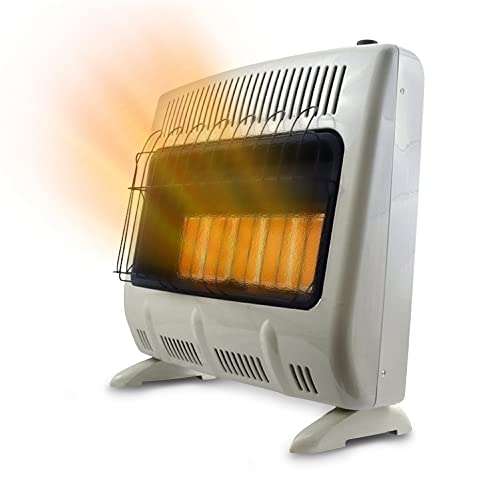
This vent-free unit provides 30,000 BTU per hour and can heat up to about 1,000 square feet. It’s a good balance for mid-size garages or shops where a plug-in heater would be insufficient. It features a battery-operated electronic ignition, which improves startup reliability in cold conditions.
Best for: Medium-sized spaces needing robust heat without external venting; users prioritizing reliable ignition.
Caution: Ensure adequate ventilation in enclosed spaces to avoid buildup of combustion byproducts.
Mr. Heater 30,000 BTU Vent Free Radiant Natural Gas Heater

This natural gas option mirrors the propane vent-free design with 30,000 BTU capacity and heating coverage up to about 1,000 square feet. It includes a battery-operated electronic ignition for easier start and does not require electricity to operate the heater function. The unit shares the same safety features that help prevent gas buildup in enclosed spaces.
Best for: Spaces connected to natural gas lines; users who want a vent-free solution without relying on propane storage.
Limitation: Like other vent-free units, proper ventilation remains essential for indoor use.
OKF Propane Heater 6k–18k BTU

This heater offers adjustable heat settings across 6,000 to 18,000 BTU, making it suitable for smaller garages, shops, or indoor spaces that require controlled warmth. It includes multiple safety safeguards, including a regulator and hose compatibility for propane supply. It’s ideal where electricity is limited or where compact footprint is needed.
Best for: Small to medium spaces; users who need adjustable heat and easier portability.
Caution: Check clearance and ventilation to ensure safe operation in confined areas.
Mr. Heater 18,000 BTU Vent Free Radiant Propane Heater

This 18,000 BTU unit is a compact option for smaller shops or home garages where space is limited. It heats up to about 700 square feet and uses an electronic ignition for reliable startup. It’s a good choice when you need a wall-mounted or floor-stable unit with efficient heat distribution.
Best for: Small to mid-sized spaces; users prioritizing compact design and electronic ignition.
Limitation: Lower BTU output means slower warm-up in larger spaces; plan for more units if heat is required for bigger areas.
Mr. Heater 20,000 BTU Vent Free Radiant Dual Fuel Heater

The dual-fuel design supports both propane and natural gas sources, delivering 20,000 BTU per hour. It heats up to 700 square feet and uses a battery-operated electronic spark ignition. This option provides flexibility for spaces with varying fuel availability and can be a sensible interim solution for mid-sized garages.
Best for: Spaces with mixed fuel options or where standby flexibility is valuable.
Caution: Dual-fuel compatibility requires correct fuel connections and adherence to safety guidelines for all fuel types.
Buying Guide: Key Considerations for Overhead Propane Radiant Heaters
What space size should you target?
Match BTU to area. Larger spaces typically need 30,000–40,000 BTU heaters for quick warmth, while smaller spaces can be comfortable with 6,000–18,000 BTU units. Vent-free models can cover up to about 1,000 square feet depending on insulation and ceiling height.
Vent-free versus vented options
Vent-free units release combustion byproducts into the room, so adequate ventilation is essential in enclosed spaces. Vent-free designs are convenient where venting isn’t possible but require proper clearance and space planning. Vented units exhaust outside, reducing indoor byproducts but needing proper ducting and installation.
Fuel type and availability
Propane is portable and widely available, ideal for garages and outdoor-adjacent spaces. Natural gas models save ongoing fuel costs but require a fixed gas line. Dual-fuel options offer flexibility in fuel choice but may add installation considerations.
Ignition and safety features
Electronic ignition improves reliability in cold conditions. Look for tip-over switches, oxygen depletion sensors (ODS), and flame-failure safety valves. Ensure the heater includes a clearance diagram and follows local code requirements.
Installation considerations
Overhead installation requires appropriate mounting or stand placement with adequate clearance from combustibles. Confirm room layout, ceiling height, and accessibility for fuel connections and maintenance. Consider escape routes and smoke detectors in work areas.
Operational efficiency and cost
Infrared radiant heaters deliver heat directly to objects and people, often with lower energy waste than large fan-forced heaters. Compare burner efficiency, flame stability, and the ability to run at lower settings to maintain comfort without excessive fuel use.
Safety and maintenance
Regular inspection of hoses, regulators, and connections is essential. Clean burners as needed and replace worn components promptly. Store propane tanks safely in ventilated areas away from ignition sources.
Selecting the best option for you
Choose based on space, fuel availability, and whether you need electricity-independent operation. For large, unpowered garages, the 40,000 BTU MH40LP is a strong choice. For enclosed, smaller spaces, vent-free 18,000–30,000 BTU models offer reliable warmth with straightforward installation. If you need flexibility with fuel sources, consider a dual-fuel or mixed-propane/NG setup.
FAQ
- Do overhead propane radiants require electricity? Some models are vent-free and operate without electricity, while others use electronic ignition and may require power for ignition and controls.
- What size heater do I need for a 400 sq ft garage? A heater in the 18,000–30,000 BTU range is typically suitable, depending on insulation and climate.
- Are vent-free heaters safe for enclosed garages? They can be, with proper ventilation and adherence to manufacturer guidelines. Ensure CO detectors are installed and vents or air exchanges are considered if necessary.
- Can I install a propane heater on the ceiling? Ceiling installation is possible with appropriate mounting hardware and clearances, but follow manufacturer instructions and local codes.
- Is a natural gas heater better than propane for indoor use? Natural gas can be cost-effective if available at the site, but propane offers portability and flexibility in spaces without gas lines.
- What maintenance is required? Regularly inspect connections, clean burners, and replace any worn parts. Schedule periodic professional checks if required by local codes.