
Answering the need for dependable on-board hot water, this guide highlights practical marine and portable propane water heaters. These options are best for boat owners, RV travelers, campers, and remote cabin users who want instant hot water without complex setups. The following selections balance capacity, efficiency, and ease of installation to fit varied spaces and demands. A quick summary table is provided for fast comparison.
| Product | Type | Best Suited For |
|---|---|---|
| Kuuma 6 Gallon Water Heater | Marine electric tank | Small to mid-sized boats needing steady hot water |
| Outdoor Propane Tankless Water Heater (6L) | Propane tankless portable | Boats, RVs, camping where portable heat is needed |
| ORBEK RV Tankless Water Heater | Propane on-demand (tankless) 12V DC | Busy RV families and campers requiring large instant hot water |
| Tankless Water Heater 4.74GPM (Outdoor) | Propane tankless portable | Camping, boats, cabins needing higher flow |
| KYGR King RV 6 Gallon | Propane 6-gallon tank with remote | RV openings for 4–6 gal tanks needing stable temp |
Kuuma 6 Gallon Water Heater for Marines and Boats

Type: Marine electric tank unit. Capacity: 6 gallons. Electrical Input: 120V-60Hz/1500W. Best for compact to mid-sized boats that need a reliable hot water supply without propane. The front-mount with rear heat exchange design helps integrate with common boat layouts. Potential limitation: Requires AC power aboard; performance depends on electrical availability.
Outdoor Propane Tankless Water Heater (6L)

Best for travelers who need instant hot water on the go. Features include ultra-slim design, portability, and a high output of up to 40,000 BTU/Hr, producing about 1.58 gallons per minute. It includes a CSA-approved regulator and multiple protection features (overheat, low flow, dry combustion, anti-freeze, high pressure, flame failure). Caution: system requires proper venting and secure mounting; performance can vary with water pressure and ambient conditions.
ORBEK RV Tankless Water Heater
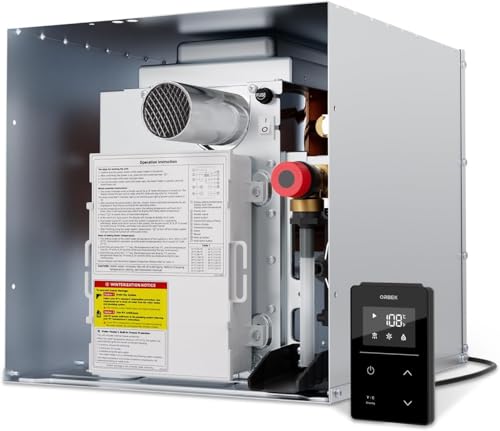
Best for busy RV families seeking immediate hot water on demand. Delivers up to 60,000 BTU per minute with on-demand heating, eliminating storage tanks and reducing standby energy. Notable for high-altitude adaptability and compatibility with RV systems via remote control. Limitation: installation requires consideration of 12V DC power and space for mounting; efficiency depends on water flow and upstream pressure.
Tankless Water Heater 4.74GPM (Outdoor)

Best for campers and boats needing strong hot-water output. Rated at 4.74 GPM with 68,000 BTU/hour maximum, it combines portability with multi-protection features including anti-freeze and flame failure protection. The compact design and battery power enable use in remote locations. Limitation: heavier and larger than ultra-portables; ensure space for installation and venting.
Tankless Propane Water Heater – 3.18GPM

Best for smaller setups that still demand reliable on-demand water. Delivers 3.18 GPM with a 167°F max temperature rise. CSA-approved regulator and safety protections (flame failure, anti-freeze, overheating) accompany a portable design. Caution: output may be lower at high elevations or with low water pressure; ensure adequate flow rate from the water pump.
KINGRVER 6 Gallon RV Water Heater

Best for 4–6 gallon RV cutouts needing stable temperature and simple remote control. Porcelain-lined steel tank provides durability; dual smart temperature control and a high-altitude mode offer consistent comfort. Better for frequent RV use where precise temperature control matters; caution: install space and connections must accommodate 1/2″ NPT and gas line routing.
Camco 11841 Kuuma Water Heater – 11 Gallons

Best for larger boats needing extended hot-water supply. 11-gallon capacity with 120V front heat exchange, rear mount. Suitable for boats that can accommodate bigger units and have ample electrical access. Caution: larger footprint and weight may require dedicated mounting space and robust support.
Tankless Propane Water Heater – 5.26GPM 20L

Best for larger demands where quick, high-flow hot water is needed. Produces 5.26 GPM with 68,000 BTU/hour, and includes digital display and multi-protection. Portable with folding handles and battery-powered operation. Caution: heavier and requires secure mounting; ensure power and gas lines are arranged safely.
Buying Guide: Key Purchase Considerations
- Water demand and capacity: Choose tank models (6–11 gallons) for steady supply; tankless models suit on-demand needs and space limitations.
- Fuel type and availability: Propane offers portability and fast heating; electric heaters rely on onboard power but can be limited by electrical capacity.
- Installation space: Check mounting options, venting requirements, and connection sizes (NPT standards).
- Voltage and power needs: Electric models require available 120V power and circuit capacity; battery or DC operation aligns with remote use.
- Protection features: Look for flame failure, anti-freeze, overheating protection, and dry-combustion safeguards for safety and longevity.
- Altitude performance: Some units include high-altitude adjustments; consider this if traveling to high elevations.
Frequently Asked Questions
- What is the main difference between tankless and tank heaters for marine use?
– Tankless heats on demand, saving space and reducing standby heat, while tank heaters store hot water for immediate use but require more space. - Do I need special venting for propane marine heaters?
– Most portable propane heaters are designed for outdoor or ventilated spaces; ensure safe mounting and proper venting per manufacturer instructions. - Can these heaters operate at high altitudes?
– Some models advertise high-altitude capability; verify with the specific unit’s performance range and adjust settings accordingly. - Which heater is best for an RV with limited space?
– Compact tankless models or small-capacity tanks are ideal when space is tight, provided the water demand matches capacity. - Is electrical power required for propane units?
– Propane tankless units may require ignition electronics or battery assistance; verify the power needs in the product specs. - Can I install these heaters myself?
– Some models are designed for DIY installation with standard fittings; others may require professional installation to meet safety standards.