
For comfortable, evenly heated floors, low voltage underfloor heating mats offer a safer and simpler setup than high-voltage systems. This guide highlights five top options and explains who each product is best for, along with practical buying tips. Perfect buyers include DIY remodelers, homeowners seeking subtle warmth under tile or laminate, and installers prioritizing quick, mess-free installations.
| Product | Best For | Key Feature | Limitations |
|---|---|---|---|
| Programmable Thermostat for House Radiant Underfloor Heating | Homeowners seeking integrated safety | Built-in GFCI and dual air/floor sensing | Requires compatible heating mats |
| VEVOR Floor Heating Mat, 30 Sq.ft | Mid-sized rooms with easy adhesive install | Self-adhesive mat with four-mode thermostat | Do not cut the cables |
| LuxHeat 20 sqft Heated Floor Mat Kit | Tile or laminate installs with modern thermostat | Self-adhesive mat and programmable thermostat | Do not cut the red heater wire |
| QuietWarmth Float QWARM3X10F240 | Floating floors like luxury vinyl or laminate | Cuttable mat to fit room layout | Mat width cannot be narrowed |
| VEVOR Floor Heating Mat, 10 Sq.ft | Smaller areas or retrofit projects | Digital thermostat with dual sensing | Smaller footprint limit heat coverage |
Programmable Thermostat for House Radiant Underfloor Heating
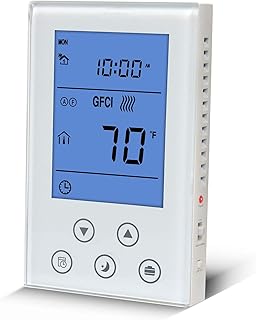
Best for safety-conscious homes, this dual-sensing thermostat supports 120V or 240V systems and delivers up to 3600W at 240V. It includes a built-in GFCI, floor and air sensors, and a GFCI test function. The external can test for leakage safely, making it ideal for households prioritizing electrical protection. Choose this if your project requires integrated safety and flexible voltage compatibility. A potential limitation is that GFCI management requires occasional navigation through a hidden menu to modify alerts.
VEVOR Floor Heating Mat, 30 Sq.ft

Best for medium rooms with straightforward installation, this mat kit includes the heating mat, thermostat, floor sensor, and installation monitor. Its 2-inch spacing and adhesive backing simplify placement under tile or thin-set floors. It’s a solid pick for do-it-yourself installers seeking a balanced price-to-performance ratio. A caution: the cable is not designed to be cut; instead, you fit the mat to room dimensions using the provided layout guidance.
LuxHeat 20 sqft Heated Floor Mat Kit

Best for tile or laminate installations seeking a premium feel, this kit includes a programmable thermostat with a floor sensor and built-in GFCI. The mats are self-adhesive with pre-spaced wiring, simplifying placement under common floor coverings. It’s a good choice when you want a reliable, long-term solution with a warranty-backed brand impression. Avoid this if your project requires cutting the red heater wire; the mat design calls for embedding in underlayment or mortar without cutting the heater itself.
QuietWarmth Float QWARM3X10F240

Best for floating floors like luxury vinyl or engineered wood, this 3×10-foot mat is designed for easy layout and minimal cleanup—no mortars or self-leveling required. It can be cut to fit room shapes, though mat width cannot be narrowed. It uses a high-efficiency design that can reduce energy usage, making it attractive for budget-conscious spaces. A limitation is that the mat width cannot be altered, so plan the room’s layout accordingly.
VEVOR Floor Heating Mat, 10 Sq.ft

Best for small spaces or retrofit projects, this kit combines a compact 10 sq ft mat with a programmable dual-sensing thermostat and built-in GFCI. It provides a straightforward upgrade to add warmth under a specific area such as a bathroom or kitchen. A caveat: coverage is limited, so it may require combining with multiple mats for larger rooms and careful planning to avoid cold spots.
Buying Guide
What should you look for when choosing low voltage underfloor heating mats?
- Voltage compatibility: Ensure the mat and thermostat support your home’s supply (120V or 240V) and that the mat’s wattage aligns with the room size.
- Thermostat features: Prioritize programmable schedules, floor sensing for accurate heat, dual air/floor sensing if available, and built-in GFCI for safety.
- Safety and codes: Look for listings and compliance marks, such as cETL or CSA, and verify that GFCI protection is included and tested.
- Installation method: Adhesive-backed mats simplify DIY installs, but some floors require embedding in mortar or leveling compounds. Check whether cutting of heater wires is permitted.
- Floor compatibility: Tile, laminate, vinyl, and hardwood may have different installation requirements. Confirm your floor type and subfloor before purchase.
- Maintenance and warranties: Consider brands with long-term support and reasonable warranties to cover the system’s lifespan.
Frequently Asked Questions
- What is low voltage underfloor heating?
It refers to heating mats designed for 120V or 240V supply that heat floors evenly while maintaining electrical safety features. - Do these systems require professional installation?
Many installations are DIY-friendly when following mat and thermostat instructions, but electrical work may require a licensed electrician. - Can I install under any floor covering?
Most work under tile, laminate, and thin vinyl. Check specific mat guidelines for compatibility with your floor covering. - Is GFCI protection mandatory for underfloor mats?
GFCI protection is highly recommended and often required by code in certain areas to reduce shock risk. - How do I prevent heat loss and ensure even warming?
Follow spacing guidelines, use a proper subfloor, and rely on thermostats with floor sensors to maintain even temperatures. - What maintenance is required after installation?
Periodic inspection of wiring and sensors is advised; test the GFCI function after installation and after any voltage changes.