
Answering the demand for cleaner, efficient hot water, these low NOx, on-demand heaters are suited for California homes with strict emission and energy guidelines. This guide highlights five models that balance ultra-low emissions, efficiency, and practical home use. The top picks target households with varying flow needs, from single-bath to multi-bath scenarios, and include options with Wi‑Fi connectivity for easy monitoring. The buyer intent is clear: choose reliable, compact, and compliant units that minimize environmental impact without sacrificing comfort.
| Product | Best For | Key Benefit |
|---|---|---|
| Rheem IKONIC 11.2 GPM (Propane) | Large homes, multi-use | High flow, EcoNet Wi‑Fi |
| A. O. Smith ATO-140H | Outdoor installs, space‑saving | Ultra-low NOx, durable copper heat exchanger |
| Rheem RTGH 9.5 GPM (Propane) | Mid to large homes | Ultra-low NOx, high efficiency, Wi‑Fi |
| Immersion Water Heater (Portable) | Temporary hot water, camping | Fast heating, portable and simple |
| Takagi T-H3S-OS-N (Natural Gas Outdoor) | Outdoor installation, compact footprint | No pilot light, ultra-low NOx |
Rheem IKONIC 11.2 GPM Propane Tankless

Best for: big homes with simultaneous hot water needs. This indoor, condensing tankless unit delivers 11.2 GPM, suitable for showers, dishwashing, and other concurrent uses. It operates on liquid propane and emphasizes energy efficiency with condensing technology. The built‑in EcoNet Wi‑Fi enables remote control, monitoring, and alerts, helping homeowners optimize temperature and energy use from a smartphone. A potential limitation is the need for proper venting and a propane supply for indoor installation.
A. O. Smith ATO-140H 100 ProLine XE

Best for: outdoor, space‑savvy installations in homes with outdoor venting. This 6.6 GPM natural gas tankless water heater is designed for outdoor use and features a compact wall‑mount design, freeing interior space. Its primary copper heat exchanger offers efficient heat transfer, stabilizing outgoing temperatures quickly. Choose this if you want an outdoor solution and have space constraints inside the building. Caution: outdoor units require weatherproofing and appropriate venting for climate control.
Rheem RTGH 9.5 GPM Condensing Tankless
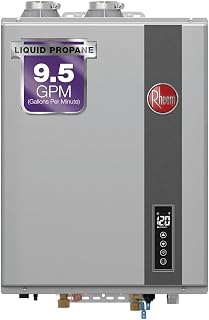
Best for: mid-to-large homes or families with several simultaneous hot water needs. This propane-powered, indoor unit provides about 9.5 GPM at a 35°F rise and leverages condensing technology with a high energy factor. It also supports Wi‑Fi connectivity for remote monitoring and control. It is suitable for homes with multi‑bath usage and wants to reduce energy bills. Limitation: installation requires proper venting and enough clearance for service access, plus a stable propane supply.
Immersion Electric Water Heater 2000W

Best for: portable, temporary hot water in small spaces or camping. This 2000W immersion heater quickly heats water in a nearby container, offering up to five gallons in minutes. It’s portable, includes a 304 stainless steel guard, and uses an LCD thermometer for temperature checks. Do not heat non‑water liquids; use with water only. Not designed as a primary household heater, but ideal for travel or temporary needs.
Takagi T-H3S-OS-N Condensing Outdoor Tankless

Best for: outdoor installations where space is at a premium and an ultra-low NOx solution is required. The Takagi T‑H3S‑OS‑N delivers on-demand hot water with a compact outdoor footprint and is designed to meet strict NOx emissions standards. It lacks a pilot light, reducing potential standby energy use. This model is suited for homes prioritizing emission compliance and minimal indoor footprint; ensure outdoor protection and proper clearances for safe operation.
Buying Guide
What should you look for in a low NOx water heater?
Key criteria include ultra-low NOx certification, high energy efficiency, appropriate GPM rating for your household, and the installation type (indoor vs outdoor). Consider whether you need Wi‑Fi connectivity for remote monitoring and alerts, which helps sustain performance and maintenance schedules.
How to choose by home size and hot water needs
Small homes or apartments with light usage can use 6–9 GPM units, while larger homes with simultaneous showers, laundry, and dishwashing benefit from 9–12 GPM or higher. If you rely on outdoor venting or have available exterior walls, outdoor models can save indoor space.
Ventilation and installation considerations
Indoor propane or natural gas units require proper ventilation and clearance. Outdoor units need weatherproofing and freeze protection in colder climates. Some models come with compact designs that save space but may require external venting or condensate drainage planning.
Energy efficiency and operating costs
Condensing technology and high uniform energy factors reduce gas and energy consumption. Wi‑Fi features help monitor usage over time, potentially lowering bills by enabling precise temperature control and maintenance alerts.
Maintenance and serviceability
Look for models with accessible service ports and clear manuals. Routine maintenance includes vent inspection (for indoor units), venting seals, and periodic descaling in hard water areas to preserve efficiency.
FAQ
- Are low NOx water heaters suitable for California’s emission standards? Yes. These models are designed to meet or exceed state emission guidelines for residential water heating.
- Can I install a tankless unit indoors in a propane system? Yes, but ensure proper ventilation, clearance, and professional installation per local codes.
- Do all these units offer smart features? Some models include Wi‑Fi connectivity for monitoring and settings remotely, while others are standard installations.
- What GPM rating do I need? Typical households with multiple simultaneous uses benefit from 9–11 GPM, depending on climate and pipe sizing.
- Is outdoor installation okay for all climates? Outdoor units are suitable in many climates but require weatherproofing and protection from freezing where applicable.
- What’s the trade-off between propane and natural gas? Propane units can be more flexible where natural gas lines are unavailable; efficiency and NOx emissions are similar across modern condensing units.