
When selecting an insulated stove pipe elbow, aim for durability, proper clearance, and compatibility with your stove type. This guide highlights five top choices that balance performance and practical installation. Best for tight spaces, outdoor setups, or retrofit projects, these elbows help maintain heat, reduce creosote buildup, and simplify clearances. The buyer types below will help you pick the right fit: compact spaces (double-wall insulated), outdoor camping or rugged use (stainless options), and standard indoor installations (single-wall and 45-degree configurations).
| Product | Key Benefit | Best For |
|---|---|---|
| DuraVent DVL 6DVL-E90 | Double-wall, reduced clearance, strong draft | Homes needing tight clearance to combustibles |
| SoloWilder Elbow Pipe 2 PCS | Stainless steel, versatile outdoor/indoor use | Outdoor camping or space-constrained installs |
| DuraVent DuraBlack 6 Inch 24 Gauge | Easy installation, 90-degree elbow for wood stoves | Single-wall, quick connects |
| Duravent DuraBlack 6″ 45 Degree Elbow | Adjustable angle, drip-free operation | Navigating corners and obstructions |
| AllFuel HST 90 Degree Elbow for 6″ | Thicker steel, through-wall installation | Horizontal through-wall setups |
The following sections review each product with its main features, ideal user, and a practical limitation to consider during selection.
DuraVent DVL 6DVL-E90 6″ Double-Wall Elbow
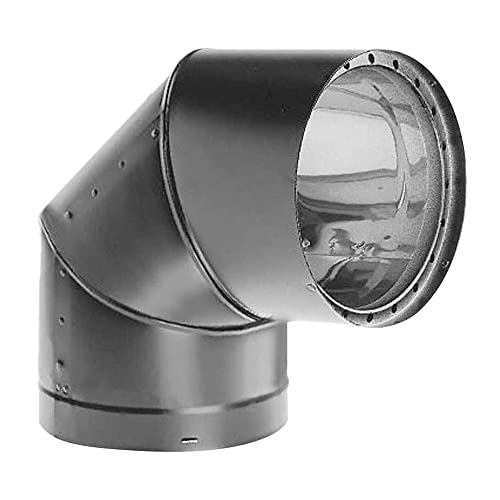
This 90-degree elbow uses a double-wall design to keep flue gases hotter for longer, improving draft and reducing creosote. The inner wall is stainless steel, and the outer wall is galvanized with a black finish, while overall construction emphasizes durability. This model also claims reduced clearance to combustibles, which can simplify installation in tight spaces.
- Best for: Fireplaces or stoves where minimal clearance to walls is required.
- Why selected: Combines insulation with robust materials to support safer venting.
- Caution: Double-wall components can be heavier and may require sturdy support during installation.
SoloWilder Elbow Pipe 2 PCS 90 Degree

Two-pack 90-degree elbows in stainless steel offer high-temperature resistance for outdoor camping stoves and indoor applications where space is limited. The joints are designed for tight connections with minimal gas leakage, and the material resists rust and harsh conditions.
- Best for: Outdoor camping stoves, or indoor installations with restricted space.
- Why selected: Stainless steel durability plus multi-pack flexibility.
- Caution: Handle with care to avoid deforming the pipe under compression during installation.
DuraVent DuraBlack 6 Inch 24 Gauge 90 Degree Elbow

This 6-inch elbow uses a single-wall design favored for straightforward wood-burning stove installations. The die-formed fittings simplify alignment with ductwork, and the 90-degree elbow is ideal for navigating corners while keeping the path clear of obstructions.
- Best for: Quick, simple wood stove vent runs with minimal components.
- Why selected: Easy installation due to die-formed fittings and straightforward connections.
- Caution: Single-wall design may vent less efficiently in very cold climates with long runs.
Duravent DuraBlack Stovepipe 6″ 45 Degree Elbow

Designed to fit 6-inch DuraBlack pipes, this 45-degree elbow offers adjustable angles to navigate obstacles. The product emphasizes a drip-free operation with precision lock-seamed and welded construction, reducing creosote leakage along joints.
- Best for: Navigating corners and obstructions in a vent run.
- Why selected: Flexible angle control helps tailor vent paths without extensive cutting.
- Caution: May require additional fittings for long runs or unusual layouts.
AllFuel HST 90 Degree Elbow for 6″ Diameter Black

This single-wall elbow is built for through-wall installations where a horizontal exit is needed. It features a thicker 21-gauge steel construction with a high-temperature black paint finish for durability and finish.
- Best for: Horizontal through-wall venting with straightforward alignment.
- Why selected: Durable gauge and finish support long-term performance in exposed installations.
- Caution: Single-wall design may be more prone to creosote buildup in long runs than double-wall options.
Buying Guide
What type of elbow do I need for my stove?
Choose double-wall elbows when you need reduced clearance to combustibles and improved heat retention. Single-wall elbows are simpler and lighter, suitable for quick installs and traditional wood stoves in vent paths with open space.
How important is material and finish?
Stainless steel provides corrosion resistance and durability, while galvanized or painted finishes offer cost-effective protection for indoor use. For outdoor or rugged environments, stainless variants are typically preferred.
Should I consider degree options?
90-degree elbows are common for direct changes in direction, while 45-degree elbows help navigate corners without abrupt bends. Some models provide adjustable angles, which can simplify installation around obstructions.
What about installation clearance and compatibility?
Check clearance to combustibles and ensure the elbow size matches your stove pipe diameter. Die-formed fittings and seamless joints reduce leaks and improve safety. If space is tight, a double-wall elbow may provide the needed clearance reduction.
Are there any installation cautions?
Some elbows are designed for specific wall-through installations or particular stove types. Avoid forcing joints or deforming pipes during assembly, and ensure all connections are securely fastened to prevent leaks.
Maintenance tips
Regularly inspect joints for gaps, clean the interior surfaces to reduce creosote buildup, and replace worn gaskets or clamps as needed. A balanced, properly vented system maintains optimal draft and safer operation.
FAQ
- Can I mix double-wall and single-wall elbows in a vent run? Yes, but ensure compatibility and maintain appropriate clearances per manufacturer guidelines.
- Do all elbows reduce clearance to combustibles? Not all; double-wall designs often reduce clearance, but verify the exact product specification.
- Is stainless steel always better than galvanized? Stainless offers corrosion resistance and durability, especially in challenging environments, but galvanized can be adequate for indoor use with proper ventilation.
- What is the benefit of a 90-degree elbow versus a 45-degree elbow? A 90-degree elbow changes direction abruptly, while a 45-degree elbow offers a gentler bend to reduce resistance and creosote buildup in some layouts.
- How do I determine the right diameter? Match the elbow to your stove pipe diameter (commonly 6 inches for many residential stoves) and account for any adapters needed for connections.