
Looking for an in-line water heater for a sink that delivers instant hot water without a bulky tank? These under-sink, point-of-use heaters provide rapid temperature elevation and compact installation for kitchens, bathrooms, RVs, or small apartments. This guide selects five compact models that balance speed, safety, and space efficiency. The best picks target different needs: fast standalone hot water at the sink, compact portability for mobile use, and dependable performance for tight spaces. Below is a quick buying table to compare key options.
| Product | Best For | Notable Feature |
|---|---|---|
| DOYXC Tankless Water Heater | Home kitchens and small apartments | Fast 82°F–131°F in seconds; compact wall-mount design |
| xwdzswgs Tankless Water Heater | Under-sink use with safety features | LED display; IPX4 waterproof; auto power-off in over-temp |
| AIYEZIDT Tankless Water Heater | Small spaces like apartments and RVs | LCD display; 3 protection features; compact, portable |
| ECOTINYMACH 3000W | Simple 110V setups with clear temp readout | Dual temperature display; energy-efficient |
| ThermoMate Mini Tank Water Heater | Sink-area instant hot water with adjustable temp | 1.3 gal capacity; compact for counters or walls |
DOYXC 110V Tankless Water Heater

Best for: small kitchens and camping setups where space is at a premium. This model heats water to about 82°F (0.3 GPM) up to 131°F (0.5 GPM) in seconds, reducing wait times for hot water by the sink. It is wall-mountable to save counter space and includes safety features such as IPX4 waterproofing and auto power-off in non-working conditions. A potential limitation is that higher flows may lower the final temperature, so plan for modest hot-water needs.
xwdzswgs Mini Under-Sink Tankless Water Heater

Best for: users seeking a compact, high-safety solution with a digital readout. This 110V unit provides rapid warm-up and features IPX4 waterproofing, leakage protection, dry-burning protection, and automatic shutdown at extreme temperatures. It’s best for households prioritizing safety and clear temperature monitoring. Note that vertical installation is recommended to avoid heating-element issues in some setups.
AIYEZIDT 110V Tankless Water Heater
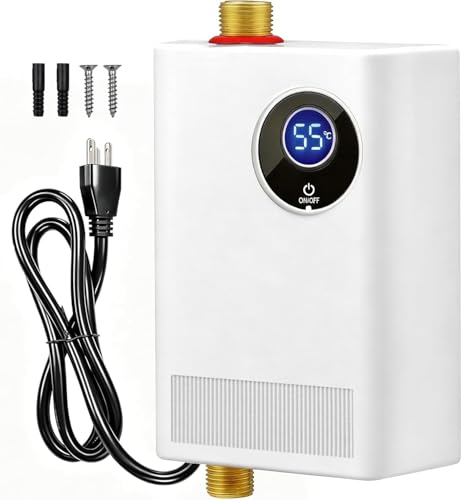
Best for: apartments, small homes, and RVs where a compact, portable option is preferred. The AIYEZIDT model uses 110V power, has a compact footprint, and includes an LCD display with multiple safety protections, making it a solid choice for point-of-use hot water. The main limitation is that flow rates may cap at lower temperatures with higher demand, so use for single-sink tasks or lighter use.
ECOTINYMACH 3000W 110V Tankless Heater

Best for: users who want a straightforward 110V unit with a dual temperature display. It delivers instant hot water and energy-efficient operation, with clear Fahrenheit/Celsius readouts for precise control. A potential limitation is that it targets standard 110V outlets; if a higher flow is desired, check compatibility with your electrical panel and available amperage.
BISELONG 2.5 Gallon Under-Sink Tank
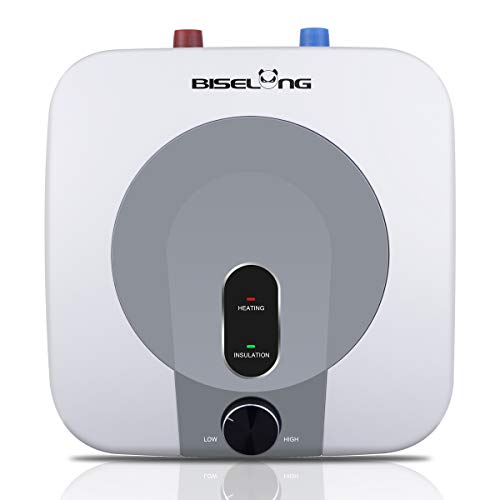
Best for: small households that need a compact storage heater with energy-saving features. This 2.5-gallon unit heats water quickly and includes an energy-saving smart inverter, insulation to reduce heat loss, and a space-saving square design. It is ideal for under-sink installations in tight cabinets but may not deliver as instant a response as a tankless model when multiple fixtures require hot water simultaneously.
ThermoMate Mini Tank Water Heater

Best for: compact setups requiring instant hot water with adjustable temperatures. The ThermoMate unit offers 1.3 gallons capacity, wall or floor mounting, and a thermostat with adjustable levels from 77°F to 140°F. It suits sinks that don’t demand very high continuous hot water. A limitation is the small tank capacity, which may require refilling for higher hot-water usage elsewhere in the home.
Buying Guide: Key Purchase Considerations
- Power and flow rate: Look for models rated around 110V with wattage from 1500–3000W for quick heat. Consider the maximum gallons per minute (GPM) you need at your intended faucet.
- Temperature control: Digital displays and adjustable thermostats help maintain stable water temps. Prefer units offering °F and °C readings for clarity.
- Safety features: IP ratings (IPX4 or higher), dry-burn protection, leakage protection, and automatic shutoff enhance reliability in small spaces.
- Installation space: Under-sink and wall-mounted designs save cabinet space. Check dimensions and mounting orientation (vertical vs. horizontal) recommended by the manufacturer.
- Electrical compatibility: Verify circuit requirements (often 110V with dedicated circuits). Ensure your panel can support the required amperage (e.g., 20–30A breakers).
- Portability vs. permanence: Portable mini heaters suit RVs and travel; fixed under-sink models suit homes and apartments with a dedicated hot-water point.
- Maintenance and durability: Stainless-steel interiors and anti-corrosion features extend life in damp kitchen environments.
Frequently Asked Questions
- Q: Do under-sink tankless water heaters require professional installation? A: Some installations may be DIY-friendly if you are comfortable wiring and plumbing, but many setups should be inspected or installed by a licensed professional.
- Q: Can these units supply hot water to multiple fixtures at once? A: Most are designed for single-sink use; high-demand scenarios may see temperature drop if flows are high at once.
- Q: What is the typical recovery time for these heaters? A: Many provide hot water within seconds to a few minutes depending on flow rate and inlet temperature.
- Q: Are these heaters energy-efficient? A: Yes, by heating water on demand, they minimize standby heat; efficiency varies with model and insulation quality.
- Q: How do I choose between tankless and small storage heaters? A: Tankless models offer instantaneous supply with less space; small storage heaters provide a quick reserve but may consume more space.
- Q: What maintenance is required? A: Periodic descaling and checking fittings help prevent mineral buildup and leaks in damp kitchen areas.