
In this guide
- Dayton Hydronic Electric Baseboard Heater (1706/1280)
- Dayton Hydronic Electric Baseboard Heater, 2560/1918 BTU
- Qmark HBB2004 Liquid Filled Electric Hydronic Baseboard Heater
- Cadet F Series 72″ Electric Baseboard Heater (Model: 6F1500W)
- Cadet F Series 30″ Electric Baseboard Heater (2F500W)
- Buying Guide: Hydronic Baseboard Heaters — Key Considerations
Hydronic baseboard heaters provide steady, quiet warmth with minimal maintenance. This guide examines five well-regarded models, highlighting their capacities, energy delivery, and safety features to help you choose the right unit for living spaces, offices, or commercial areas.
Overview of selected products:
| Product | Brand | Voltage | BTU / Watt | Key Benefit |
|---|---|---|---|---|
| Dayton Hydronic Electric Baseboard Heater, 1706/1280 BTU | Dayton | 208/240V | 1706/1280 | Commercial grade; reliable performance |
| Qmark HBB2004 Liquid Filled Baseboard Heater | Marley | 240V | 2000W | Liquid-filled for stable temperatures |
| Cadet F Series 72″ Electric Baseboard Heater | Cadet | 240/208V | 1500/1125W | Heavy-duty steel, versatile mounting |
| Dayton Hydronic Electric Baseboard Heater, 2560/1918 BTU | Dayton | 208/240V | 2560/1918 | Commercial performance with solid heat output |
| Cadet F Series 48″ Electric Baseboard Heater | Cadet | 240/208V | 1000/750W | Compact, easy to install |
Dayton Hydronic Electric Baseboard Heater (1706/1280)

The Dayton unit offers a conventional housing suitable for commercial applications with hydronic heating performance. It provides dual voltage compatibility (208/240 VAC) and dual current ratings (2.1/1.8 A), which supports scalable heat output in larger spaces. This model emphasizes robust construction and reliable operation in busy environments.
Dayton Hydronic Electric Baseboard Heater, 2560/1918 BTU
This Dayton model increases heat output for larger commercial spaces, delivering 2560 BTU (1918 W) at 208/240 VAC. Like other hydronic units, it operates quietly with minimal maintenance, making it suitable for offices, clinics, or classrooms where loud components are undesirable.
Qmark HBB2004 Liquid Filled Electric Hydronic Baseboard Heater

The Marley Qmark HBB2004 uses a liquid-immersed heating element to minimize temperature swings and maintain warmth after shutdown. Its fanless design promotes silent operation, while a thermal cutoff enhances safety on different flooring surfaces, including tile and carpet. This makes it a strong option for patient rooms, libraries, or quiet workspaces.
Cadet F Series 72″ Electric Baseboard Heater (Model: 6F1500W)

Cadet’s F Series combines a durable 25-gauge steel cabinet with a 20-gauge junction box, delivering 1500/1125 W at 240/208 V. The unit’s all-metal construction and powder coating emphasize long-term reliability, while universal wiring and pre-punched knockouts simplify installation. It is well-suited for commercial offices and multi-room settings where robust heat is necessary.
Cadet F Series 30″ Electric Baseboard Heater (2F500W)
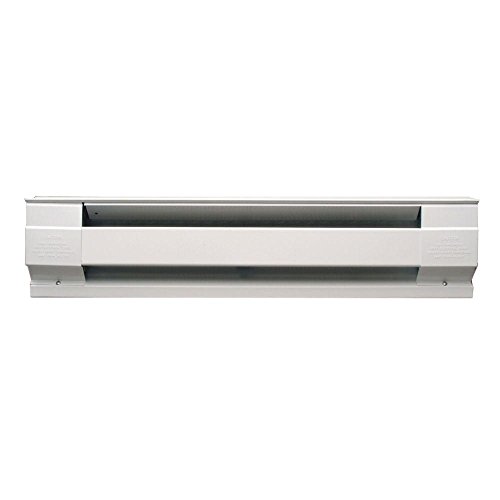
Cadet’s 30-inch model provides 500/375 W of heat at 240/208 V, making it an adaptable option for smaller rooms or zoned heating. Its universal wiring and knockouts support straightforward installation, while convection-style operation helps distribute warmth evenly across the space.
Buying Guide: Hydronic Baseboard Heaters — Key Considerations
When selecting a hydronic baseboard heater, consider space size, insulation, and desired heat output. Larger rooms typically benefit from higher BTU ratings or multiple units. For spaces with noise sensitivity, fans are unnecessary; liquid-filled or convection designs can minimize sound. Voltage compatibility (208/240 V) informs wiring requirements and electrical panel capacity.
Installation environment matters. Concrete floors and tile may impact heat distribution differently than carpeted spaces. Look for units with thermal cutoffs or built-in safety shutoffs to reduce overheating risk, particularly in homes with children or pets. If the heater will run for extended periods, verify that the cabinet is durable and resistant to wear from foot traffic or cleaning routines.
Thermal performance and energy efficiency are essential for ongoing costs. While higher wattage often means faster comfort, it can also raise electricity usage. For mixed-use spaces, consider modular configurations or multiple quieter units to maintain even temperatures without excessive peak demand.
Maintenance and service availability should be weighed. Hydronic systems typically require less daily maintenance than fan-forced units, but selecting a model from a reputable brand with clear warranty terms reduces long-term risk. Always confirm compatibility with your thermostat strategy, whether you prefer a simple line-voltage stat or an integrated control system.
Compatibility with flooring and mounting options ensures safe installation. Some models are designed for floor mounting, others for wall mounting, and some offer both. Ensure the mounting method aligns with room layout and accessibility for service if needed. Finally, verify that the unit’s dimensions match available space to avoid obstructions and ensure proper heat dispersion.