
Find the right heating jacket for pipes to prevent freezing and keep water flowing in cold weather. This guide highlights five reliable self-regulating options, suitable for residential and light commercial use. Best for homeowners, RVs, and tiny business setups that need dependable freeze protection without constant monitoring. The products below balance safety, installation ease, energy efficiency, and durability to help you choose with confidence. A quick buyer summary follows the product section in a compact table for fast comparison.
| Product | Length | Watt per Foot | Best For | Key Benefit |
|---|---|---|---|---|
| HEATIT 6ft Self-Regulating Cable | 6 ft | 7 W/ft | Water-filled pipes in moderate climates | Pre-assembled with thermostat and indicator for easy install |
| HEATIT 30ft Self-Regulating Cable | 30 ft | 3 W/ft | Long runs or exposed pipes | Low power usage with extensive coverage |
| JDZKOMKE 30 ft Pipe Heating Cable | 30 ft | 5 W/ft | Metal and plastic pipes; coastal/high-salinity areas | Triple-layer armor for durability |
| MAXKOSKO 6ft Self-Regulating Cable | 6 ft | 5 W/ft | Smaller projects and tight spaces | Compact set with cord and smart regulation |
| Methuker 24 ft Heating Cable | 24 ft | 5 W/ft | Extended runs; RVs and vehicles | Self-regulating with energy-efficient operation |
HEATIT Heating Cable – CSA & ETL Approved
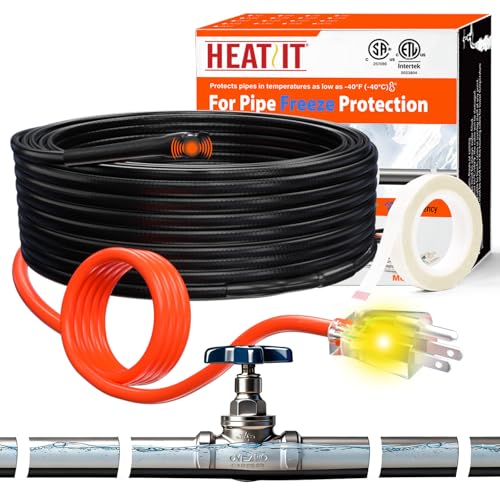
The HEATIT 6ft self-regulating heating cable is CSA and ETL certified for safety. It includes a built-in thermostat with an indicator light and operates at 120V, 7W/ft. It’s designed for water-filled plastic (includingPEX) or metal pipes and turns on at 37°F and off at 50°F. Best for small-to-medium pipe runs in temperatures where you need reliable, auto-regulating heat with straightforward installation. A potential limitation is that the cable is optimized for shorter runs and may require multiple segments for longer pipelines.
HEATIT 30ft Self-Regulating Pipe Heating Cable

This 30-foot cable provides extended coverage for longer pipe runs and colder climates. It offers ETL certification, a built-in UL-listed plug, and self-regulating heating to maintain flow down to -40°F (-40°C). Includes a 2-foot power cord. Suitable for metal or plastic pipes with a focus on energy efficiency across longer installations. Best for longer exterior lines or for protecting multiple sections along a pipeline. Beware that longer installations may require careful routing to avoid pinch points or overlapping cable sections.
JDZKOMKE 30 Ft Pipe Heating Cable
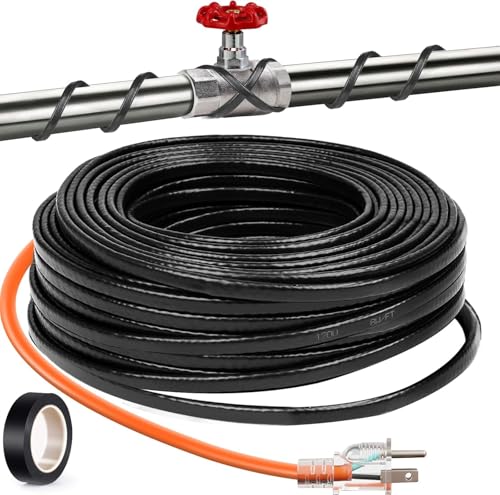
JDZKOMKE’s 30-foot cable emphasizes full-cable certification and durable construction. It uses a pure copper core, an aluminum shield, and a weather-resistant jacket to protect metal and plastic pipes down to -40°F. The kit includes a 5-foot grounded plug with an indicator light and is backed by product liability insurance. Best for exposed or coastal environments where moisture, UV, and chemicals are considerations. A limitation is that the full 30-foot setup may be more than needed for short runs, potentially increasing upfront cost.
MAXKOSKO 6ft Self Regulating Heat Tape

MAXKOSKO offers a 6-foot heating tape with a built-in thermostat and a 3-foot power cord. It protects pipes down to -40°F and maintains flow by auto-adjusting heat output to prevent overheating. The cable’s self-regulating design makes it a practical choice for smaller projects or space-constrained installations. Best for single short runs or vertical drops where easy routing is critical. Limitation: for very long runs, multiple segments may be required to cover all sections, which could complicate installation.
Methuker 24 Ft Heating Cable

Methuker’s 24-foot heat tape uses self-regulating technology to automatically adjust heat output, helping prevent overheating. It provides 5W/ft and operates down to -40°F, with a built-in thermostat and a 24-foot power cord that helps maintain a proper distance between the thermostat and plug. Best for mid-length runs and RVs or vehicles needing reliable freeze protection. A potential limitation is that longer runs still require careful layout planning to avoid overlapped cables or hotspots.
Buying Guide
What to consider when choosing a heating jacket for pipes:
- Certifications: Look for full-cable certifications (CSA, ETL, NSF61) rather than plug-only certifications for complete safety and compliance.
- Pipe material compatibility: Ensure the cable works with both metal and plastic pipes (copper, PVC, PEX).
- Length vs. coverage: Choose the length to cover required pipe runs; longer cables may be necessary for extended exterior lines or multiple segments.
- Wattage and energy use: Higher wattage means faster response but higher energy use. Self-regulating cables help balance heating with electricity costs.
- Installation complexity: Pre-assembled cables with built-in thermostats are easier to install; consider the accessibility of the thermostat location.
- Environmental durability: For exposed or coastal sites, look for rugged jackets, UV and chemical resistance, and IP ratings.
- Safety margins: Favor designs with clear safety features such as indicators, auto-shutoff, and certified plugs as part of a fully certified system.
FAQ
- What is a heating jacket for pipes?
An electrical heating cable designed to prevent pipe freezing by providing controlled warmth to water-filled pipes. - Do these cables require professional installation?
Most are DIY-friendly with simple plug-and-play design, but always follow the manufacturer’s instructions for safe use. - Will a heating cable work on plastic pipes?
Yes, many are rated for both metal and plastic pipes, including PEX and PVC. - Can I use a heating cable on multiple pipe runs?
Yes, but ensure full-cable certification and plan cable routing to avoid overlapping and overheating. - What climates require heating cables?
Cold climates with risks of pipes freezing, especially areas that experience subfreezing temperatures and wind chill. - Are there safety concerns with self-regulating cables?
Self-regulating cables adapt heat output to prevent overheating, but follow clearance guidelines and keep insulation intact for best performance.