
If you’re shopping for a reliable roof de-icing or pipe heat solution, you’re likely seeking a durable heating element that can withstand harsh cold, resist moisture, and provide steady performance. This guide highlights five top options best suited for roof gutters, downspouts, and exposed plumbing. It targets homeowners and property managers who want straightforward installation, clear safety credentials, and predictable operation during freezing weather. The table below summarizes the featured products to help you compare at a glance.
| Product | Best For | Key Benefit |
|---|---|---|
| 3FT~200FT SZFY Heat Tape | Homeowners with long roof lines | Wide length range; high heat efficiency |
| TOPDURE Roof & Gutter De-Icing Cable | Roof gutters with safety certifications | Extensive safety certifications; universal use |
| HEATIT HIRD 60FT | Pipe and roof protection combo | Durable insulation and shielding |
| YeloDeer 36 FT | Compact installations | Self-regulating energy optimization |
| HEATIT JHSF1 75FT | Long-run pipe protection | Self-regulating with broad compatibility |
SZFY 3FT~200FT Heat Tape, -40°F Deicing Cable
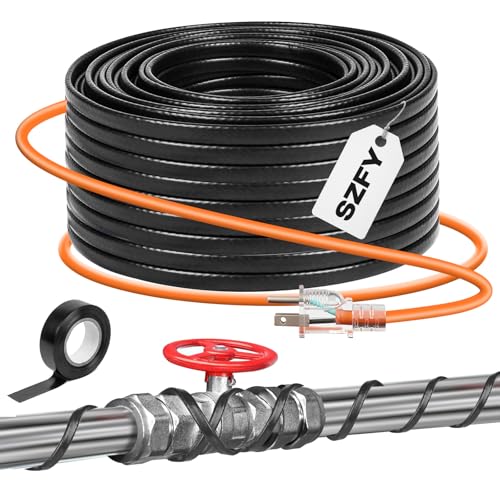
The SZFY heat tape is designed for multi-scenario use, including roof snow removal, gutter heat cables, and water-pipe heating. It covers a broad length range from 3 feet up to 200 feet and is rated to function in subzero conditions down to -40°F. The copper core enhances both heating efficiency and energy savings, making it a practical choice for long roof runs or extensive gutter networks. The cable features a 120V supply and an IP67-rated plug assembly with an 18-foot lead and indicator light for quick verification after installation.
Best for: Homeowners with long roof lines or large gutters who want a single solution across multiple outdoor winter needs. It’s well suited for barns, stables, and outdoor plumbing protections. Caution: Ensure the heated section does not overlap with itself or touch other cables to prevent overheating.
TOPDURE 100FT Roof & Gutter De-Icing Cable

This TOPDURE model emphasizes safety through ETL and CSA certifications for both the cable and plug. It is engineered to prevent ice dam formation and maintain water flow through gutters and downspouts. The constant-wattage design helps maintain consistent heat output, and the product is suitable for metal or plastic gutters and various roof types. It’s available in multiple lengths to fit most installations. Caution: Do not allow heated sections to touch or overlap with other de-icing cables during operation.
Best for: Roofs with gutters and downspouts that require dependable, certified safety for winter use. Choose this if you value full certification coverage from cable to plug. Limitation: Must follow clear unrolling and spacing instructions to avoid overheating.
HEATIT HIRD 60FT Roof & Gutter De-Icing Cable

HEATIT HIRD is built with durable XLPE insulation and a shielding assembly that includes aluminum foil and tin copper braid for enhanced safety. It is fully ETL and CSA certified, with a UL-certified plug for added protection. The kit emphasizes careful installation: completely uncoil before use and avoid touching the heated portion to itself. The shorter 60-foot length is ideal for smaller roof spans or tight gutter runs. Caution: Proper unrolling and heat-up checks should be performed before final operation.
Best for: Customers needing strong safety credentials and a robust, corrosion-resistant construction for mid-length roof and gutter work. Better for smaller properties or when you don’t require very long cables.
YeloDeer 36 FT Self-Regulating Roof Gutter Heating Cable Kit

This compact kit uses self-regulating technology to adjust heat output with ambient temperature, helping prevent overheating while saving energy. It’s designed to melt snow and prevent ice dams on roofs, gutters, and downspouts. Installation is straightforward: unroll and secure along shingles or inside gutters using clips and spacers. The short length makes it ideal for smaller homes or tight installations. Caution: Self-regulating cables may not deliver maximum heat at extremely low temperatures; for very harsh climates, a longer length or higher wattage may be preferable.
Best for: Small residences or apartments where a compact, energy-aware solution is preferred. Choose this if you want automatic protection against temperature swings without complicated controls.
HEATIT JHSF1 Self-Regulating Heating Cable, 75FT

HEATIT JHSF1 offers self-regulating heating along a 75-foot length intended for roof and pipe protection. It is ETL certified with a UL-certified plug, emphasizing a safety-first approach across North America. The cable can be used on both plastic and metal piping and in various configurations, including straight runs, spirals, and overlaps. It supports shielding and insulation for extended use and includes guidance on insulation thickness for extremely cold environments. Caution: Follow manufacturer recommendations on insulation thickness to ensure adequate freeze protection in severe frost conditions.
Best for: People seeking a versatile, long-run self-regulating option that can protect both pipes and roof areas. Better for installations requiring flexible routing and multiple layouts.
Buying Guide
Key considerations when choosing a roof and pipe heating element:
- Heat output and length: Longer runs require higher total wattage; ensure the chosen length matches your roof/gutter span.
- Power supply and safety: Look for ETL/CSA certifications, fully certified cables, and UL-certified plugs for North American use.
- Self-regulating vs constant wattage: Self-regulating cables adjust heat with temperature, reducing energy waste. Constant wattage cables provide steady heat but require careful spacing to avoid overheating.
- Installation and maintenance: Uncoil fully before use, avoid overlapping heated sections, and secure cables with appropriate clips or spacers.
- Insulation and protection: Adequate insulation around pipes and protection against moisture and abrasion extend cable life and performance.
- Compatibility: Consider whether the cable is suitable for your roof material (asphalt, metal) and gutter type (plastic, metal).
Frequently Asked Questions
- What is the typical wattage for roof de-icing cables?
– Most cables use a wattage per foot in the 5W/ft to 11W/ft range, depending on the model and climate needs. - Do these cables require professional installation?
– Many installations are DIY-friendly, but always follow manufacturer guidelines and local electrical codes for safety. - Can I use self-regulating and constant wattage cables together?
– It’s generally best to avoid mixing technologies in one system to prevent inconsistent heat or electrical load issues; follow the manufacturer’s guidance. - How do I prevent ice dams effectively?
– Combine a properly rated roof/de-icing cable with good insulation, ventilation, and insulation of gutters and downspouts where applicable. - Are all de-icing cables weatherproof?
– Look for IP ratings and protective jackets designed for outdoor use; ensure the system is rated for exterior conditions including moisture and cold. - What maintenance is required after installation?
– Inspect for wear or damage after extreme weather, ensure connections remain dry, and replace any damaged sections promptly.