
Answering the question: which gas-powered garage space heaters offer solid warmth, safety features, and clear suitability for garages, barns, and workshops? This guide highlights five top options, explaining who each is best for and why. It’s ideal for DIYers, car enthusiasts, and small-shop users who need reliable heat in well-ventilated spaces. A quick summary table of the five products is provided below to help you compare at a glance.
- Best for large garages: Mr. Heater 80,000 BTU Forced-Air Unit Heater (Propane or Natural Gas)
- Best budget option for mid-sized spaces: Mr. Heater 50,000 BTU Forced-Air Unit Heater (Propane or Natural Gas)
- Best vent-free option for small to medium spaces: Mr. Heater 30,000 BTU Vent Free Blue Flame Natural Gas Heater
- Best infrared comfort for efficiency: EdenPURE CopperPLUS Infrared Heaters for Indoor Use Portable 1000 Sq Ft
- Best kit for ready-to-install gas hookups: Stanbroil One Stop Gas Appliance Hook Up Kit with Ball Valve and Gas Line
| Product | Best For | Notes |
|---|---|---|
| Mr. Heater 80,000 BTU | Large garages and workshops | Ceiling-mounted, heats up to 2,667 sq ft |
| Mr. Heater 50,000 BTU | Medium garages (roughly 1,667 sq ft) | Ceiling-mounted, compatible with thermostats |
| Mr. Heater 30,000 BTU Vent Free | Smaller spaces up to 1,000 sq ft | Vent-free natural gas design |
| EdenPURE CopperPLUS Infrared | Indoor comfort in any space | Infrared heat for targeted warmth |
| Stanbroil Gas Hook Up Kit | DIY installs | Includes ball valve and gas line for setup |
Mr. Heater 80,000 BTU Forced-Air Unit Heater

This ceiling-mounted unit is designed to heat large spaces such as garages, barns, and workshops. It delivers up to 80,000 BTUs to cover roughly 2,667 square feet, making it a strong option for bigger spaces or high-ceiling areas. Best for buyers who need rapid, whole-space warmth in sizable environments. A potential limitation is that color may vary between grey and tan, which may affect appearance in your space.
Mr. Heater 50,000 BTU Forced-Air Unit Heater

This ceiling-mounted unit delivers 50,000 BTUs and heats up to about 1,667 square feet, making it suitable for medium garages or three-car spaces. It is compatible with standard 24-volt thermostats or newer Wi-Fi enabled thermostats (sold separately), which adds flexibility for temperature control. Best for buyers who want solid mid-size performance with thermostat compatibility to help maintain consistent heat. A limitation is that it requires compatible thermostat integration to maximize efficiency.
Mr. Heater 30,000 BTU Vent Free Blue Flame Natural Gas Heater

This vent-free model emits 30,000 BTU per hour and heats up to about 1,000 square feet. It features a battery-operated electronic ignition (battery included), enabling convenient startup. Best for smaller garages or workshops where venting is limited and direct heat is desired. Consider a limitation: vent-free units may require proper ventilation and clearance to ensure safe operation.
EdenPURE CopperPLUS Infrared Heaters

These portable infrared heaters provide indoor warmth with targeted heat over up to 1,000 square feet. The CopperPLUS model emphasizes efficient heat transfer and can be moved as needed within the space. Best for buyers who want movable, infrared warmth that can supplement or extend space heating. A caution: infrared units heat objects and people directly, so personal distance and placement matter for comfort and safety.
Stanbroil One Stop Gas Appliance Hook Up Kit
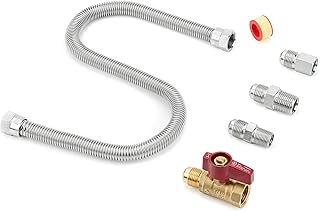
This kit provides a ready-to-install gas hookup solution with a ball valve and gas line, ideal for DIYers planning to connect a gas space heater. Best for buyers who want a convenient setup option and a straightforward installation path. A limitation is that exact compatibility with local gas lines and building codes should be verified before purchase.
Buying Guide
Key considerations when choosing a gas-powered garage heater include space size, heater type, venting requirements, and thermostat integration.
- Space size and BTU needs: Larger garages require higher BTU units (e.g., 80,000 BTU for bigger spaces), while smaller areas can be adequately heated with 30,000 BTU units.
- Ventilation: Vent-free units are convenient for spaces with good ventilation but require proper clearance and air quality considerations. Vented or ceiling-mounted units may necessitate installation work and clearances.
- Thermostat compatibility: Some units work with standard or Wi-Fi thermostats for automatic temperature control. Consider your existing setup and whether you want smart home integration.
- Installation: Ceiling-mounted units save floor space but require secure mounting and professional installation in many cases. Gas hook-up kits simplify DIY projects but must meet code requirements.
- Safety and clearances: Follow manufacturer guidelines for clearance from flammable materials and proper exhaust routing where applicable. Keep children and pets in mind for placement.
Frequently Asked Questions
- What size garage heater do I need for a two-car garage? — A two-car garage typically needs 40,000 to 60,000 BTU depending on climate, ceiling height, and insulation. A ceiling-mounted 50,000 BTU unit is often a good mid-range choice.
- Can I use a vent-free heater in a garage? — Vent-free heaters are suited for spaces with adequate ventilation and space clearance. Ensure proper venting and safety guidelines are followed for indoor air quality.
- Are infrared heaters more efficient for garages? — Infrared heaters deliver direct warmth to objects and people, which can feel more efficient for spot heating and quick warmth in transient workshop use.
- Do I need a professional to install a gas heater? — For high-BTU units or vented installations, professional installation is often recommended to meet safety codes and ensure proper venting and gas connections.
- Can I run a gas heater with a smart thermostat? — Many models support standard 24-volt or newer smart thermostats, enabling easy temperature control and energy management.
- What maintenance is required for gas heaters in garages? — Regular checks include gas connections, venting (if applicable), and ensuring clearances are maintained around the heater for safety.