
Answering to the common home upgrade question, these electric water heaters cover a range of needs—from compact under-sink installs to whole-house solutions. The following picks are suitable for different household sizes and hot-water demands, with a focus on clear energy use, space savings, and ease of installation. This guide highlights who each heater is best for and why it was selected, plus practical cautions to consider before purchasing.
| Product | Type / Capacity | Best For |
|---|---|---|
| Rheem 18kW Tankless Electric | Tankless, 18 kW, 240V | Homes needing on-demand hot water with space savings |
| GE 18 Gallon Plug & Play | Small storage tank, 18 gal | Compact installs in apartments or tiny homes |
| Rheem PROE50 50-Gallon | Storage tank, 50 gal | Medium to large households, replacing older tanks |
| WINTEMP 27kW Tankless | Tankless, 27 kW, 240V | Whole-house performance with higher flow |
| SIVUATEK 14kW Tankless | Tankless, 14 kW, 240V | Under-sink or point-of-use needs |
Use this article to compare features, installation notes, and suitability for your living situation. Each product section below outlines who benefits most, practical considerations, and a concise rationale for selection.
Rheem 18kW Tankless Electric Water Heater
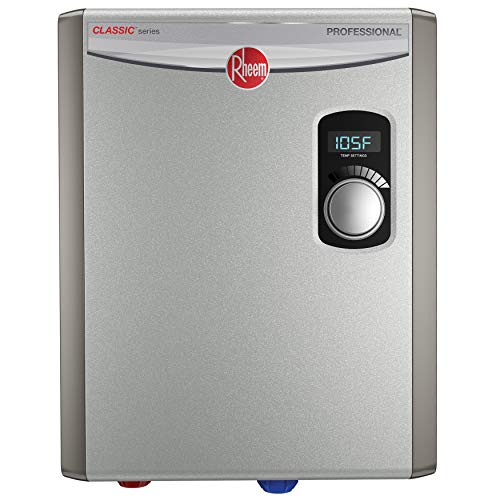
Best for homes that want on-demand hot water with compact equipment. This unit uses external digital thermostatic control with LED display and self-modulation to adjust power to meet demand. Copper immersion elements promise durability, and serviceability is field-friendly. Flow rate can reach up to 4.4 GPM, suitable for one or two points of use depending on demand. A practical pick for households with limited space and a preference for continuous hot water without tank storage.
Who it’s best for: small to mid-sized homes or retrofit projects where space is at a premium and a steady hot-water supply for a couple of fixtures is sufficient. Choose this if you want precise temperature control and a compact footprint. Caution: at higher simultaneous demands (e.g., multiple showers), performance depends on incoming water temperature and overall plumbing layout.
GE Appliances 18 Gallon Plug and Play Electric Water Heater

Best for consumers needing simple, quick installation in limited spaces. This model provides flexible whole-home hot water by serving a single hookup or small living spaces such as condos or cabins. Its compact design makes it a good fit where bulkier tanks won’t work, and it connects to a standard 120-volt supply with common 3/4-inch NPT connections. Caution: 120-volt units typically support lower flow rates than higher-voltage tankless systems, so ensure your hot-water expectations align with the unit’s capacity.
Rheem PROE50 50-Gallon Tank

Best for larger households needing a reliable primary hot-water source. The 50-gallon capacity supports 3–5 people or homes with multiple bathrooms, providing ample hot water while occupying less space than some competing models. Rheem’s trusted engineering underpins a robust hot-water supply for daily routines. Caution: installation space and electrical service should be evaluated to ensure compatibility with a higher amperage unit.
WINTEMP 27kW Tankless Electric Water Heater

Best for whole-house hot water with higher demand. The 27 kW rating supports a higher maximum hot-water output (up to about 6.5 GPM) and uses self-modulating energy management for efficiency. It’s recommended for homes with two to three bathrooms in moderate climates. Caution: a robust electrical service (200 A recommended) and professional installation are required due to higher amperage and complex wiring.
SIVUATEK 14kW Tankless Under-Sink Hot Water
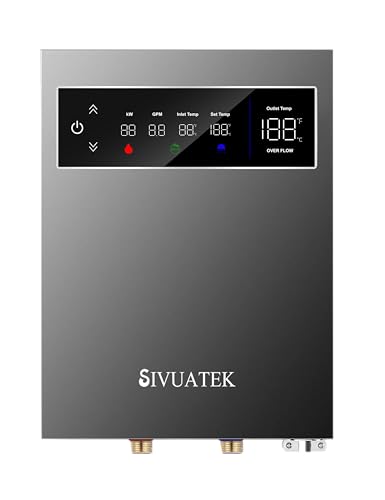
Best for point-of-use needs like under-sink or bathroom vanity setups. With 14 kW output and a compact form factor, this unit delivers instant hot water without preheating for smaller loads. It’s a strong choice when the goal is to avoid long waits and to install close to a specific faucet. Caution: not ideal for heavy-shower usage or entire-home pairing; smaller flow means limited simultaneous usage.
Buying Guide: How To Choose The Right Electric Water Heater
- Whole-home vs point-of-use: Tank-style units provide storage and are better for larger households; tankless options save space but may require multiple units for high simultaneous demand.
- Power requirements: Tankless heaters often need 240V and higher amp service. Ensure your electrical panel can support the unit and that wiring meets local codes.
- Flow rate and hot water needs: Estimate gallons per minute (GPM) needed for showers, sinks, and appliances. Select a model whose maximum GPM aligns with daily usage.
- Space and installation: Compact units fit apartments and utility closets; larger tanks require more physical room and robust plumbing connections.
- Efficiency and cost considerations: Self-modulating tech helps reduce energy use. Consider energy savings versus upfront equipment costs and installation complexity.
- Durability and serviceability: Copper elements and field serviceability support longer life and easier maintenance in some models.
Common Scenarios And Recommendations
- Small apartment or kitchenette: GE 18 Gallon Plug & Play is a practical, space-conscious option.
- Two-bathroom home with limited space: Rheem 18kW Tankless provides on-demand hot water without bulky storage.
- Medium to large family with consistent hot-water needs: Rheem PROE50 50-Gallon is a reliable storage option.
- Household with higher simultaneous demand: WINTEMP 27kW Tankless is designed for bigger flow across rooms but requires a strong electrical setup.
- Under-sink hot water or single-use fixtures: SIVUATEK 14kW is a solid point-of-use choice for quick access to hot water near a faucet.
Frequently Asked Questions
- What size electric water heater do I need? Consider the number of occupants, number of bathrooms, and desired hot-water availability. Tankless models scale with demand, while storage tanks depend on typical daily use.
- Do I need a professional to install an electric water heater? Yes. Electrical work and building code compliance usually require a licensed electrician, especially for high-wattage tankless units.
- Are tankless heaters more energy-efficient? They often use energy on demand, which can reduce standby losses, but overall savings depend on usage and installation.
- Can I replace an older water heater with a newer model? Replacement compatibility depends on existing plumbing connections, electrical service, and available space. Some models offer easier retrofits than others.
- What maintenance is needed? Regular inspection of connections, thermoregulation settings, and periodic flushing of storage tanks helps extend life and performance.
- Is a higher GPM rating always better? Higher GPM supports more simultaneous hot-water use. Match GPM to your typical daily needs rather than chasing the maximum rating.