
Answer: For garage spaces that demand quick, directional warmth, electric forced-air heaters with blowers are the fastest option. These models provide rapid heat, simple installation, and adjustable output for varied workshop conditions. This guide highlights five top picks that balance power, durability, and practical features for an American garage environment. Each option targets specific buyer needs, from compact, portable units to ceiling-mounted solutions for space-saving setups.
Summary of chosen products
| Product | Best For | Key Feature | Notes |
|---|---|---|---|
| Dura Heat EUH1465 Electric Forced Air Heater | Small bays and workbenches | Pivoting base for directional heat | Durable steel housing; 1500W heating |
| Dura Heat EUH1500 Electric Forced Air Heater | Medium-sized spaces up to 250 sq ft | Built-in thermostat | Overheat protection; directional stand |
| Comfort Zone 5,000W Ceiling Mount | Space-constrained garages and warehouses | Ceiling-mounted, fan-forced | Robust steel, 240V, ETL compliant |
| Hanging Electric Patio Heater by Sundate | Outdoor garages and covered patios | Infrared, wall-mounted, WiFi control | Multiple heat levels, weather-ready design |
| Dura Heat 240V EUH4000 | Large garages and workshops | High wattage, 240V operation | Higher heat output; 4000W model |
Dura Heat EUH1465 Electric Forced Air Heater with Pivoting Base

Best for compact garage nooks and workbenches that need quick, directional warmth. This unit delivers 1500W of PTC ceramic heating for fast comfort. The pivoting base supports angled heat flow to work zones, and its rugged steel construction withstands regular workshop use. Suitable as a heater or a fan-only circulator depending on season. Caution: smaller spaces may heat up quickly; ensure proper clearance around any flammable materials.
Dura Heat EUH1500 Electric Forced Air Heater

Best for mid-size garages up to roughly 250 square feet. This model includes a built-in thermostat and an adjustable stand for directional heat. It offers an overheat shut-off as a safety feature. The combination of thermostat control and portable design makes it a solid pick for spaces that need dependable, moderate heat. Limitation: performance may decline in larger areas without supplemental heating.
Comfort Zone Hard-Wired Ceiling Mount Garage Electric Space Heater

Best for wall- and floor-space constrained garages where overhead mounting is feasible. This 5,000-watt ceiling-mount heater uses a fan-forced design to efficiently spread warmth from above. Its robust steel construction and overheat protection help it endure challenging environments. Choose this if ceiling mounting is possible and you want to keep floor space clear. Caution: installation requires hard-wired power and appropriate mounting hardware.
Hanging Electric Patio Heater With Light (Sundate)

Best for versatile indoor-outdoor use in garages that double as covered outdoor spaces. This infrared heater delivers 1500W with 9 heat levels and 24-hour timers, plus WiFi control for remote operation. Ideal when you want controlled, zone-specific warmth in semi-exposed areas. Limitation: infrared heat is directional and may not warm distant corners as effectively as convection heaters.
Dura Heat EUH4000 240V Electric Space Heater
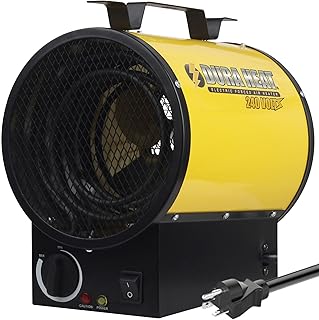
Best for larger garages and workshops that require substantial heat output. This 240V space heater operates at high wattage, delivering robust warmth for bigger areas. It is a practical choice when space is available for bulk heating. Caution: ensure electrical capacity can support sustained 4000W operation, and plan for proper ventilation to manage heat in enclosed spaces.
Buying Guide: Key Purchase Considerations
Heat output and space: For garages under 150 sq ft, 1500W models often suffice. For larger spaces, look at 250–4000W options, balancing power with electrical supply availability (110V vs 240V).
Installation and placement: Portable units are ideal for flexible spots, while ceiling-mount or hard-wired models save floor space. Consider overhead mounting if the garage has exposed ceiling joists and you want unobstructed workspace.
Controls and safety: Look for thermostats, overheat protection, and auto shut-off. Some units offer remote or WiFi control for timed or remote operation, which can improve energy efficiency.
Heat type and distribution: Forced-air blowers offer quick warmth and directional air flow, whereas infrared heaters deliver steady warmth at a distance. Choose based on whether you need immediate heat for a zone or even overall warming for the space.
Durability and build: Steel housings and reinforced frames improve longevity in workshop environments. Consider units with rugged finishes to resist dust, humidity, and incidental knocks.
Electrical requirements: Confirm amperage and voltage compatibility (120V vs 240V). Higher-wattage units may require dedicated circuits or professional installation to meet electrical codes.
FAQ
- What size heater do I need for a typical garage?
Most small to medium garages (100–250 sq ft) perform well with 1500–3000 watts. For larger spaces, consider 4000 watts or more and check electrical capacity. - Is a ceiling-mounted heater better than a portable one?
Ceiling-mounted units save floor space and can deliver uniform heat in tall garages; portable heaters offer flexibility for temporary or multiple work zones. - Do these heaters require professional installation?
Some models are plug-in and portable, while others (especially ceiling mounts and hard-wired units) may require electrical work and professional installation. - Are infrared heaters suitable for garages?
Infrared heaters are effective for directing warmth to people and objects without warming the air first, which can be advantageous in open or drafty garages. - What safety features should I look for?
Overheat protection, tip-over shut-off, auto shut-off on insufficient ventilation, and clear clearance guidelines from combustibles are essential. - Can I use these heaters year-round?
Yes, if you use them to supplement climate control. In cold months they provide rapid warmth; in warmer months, fan settings can circulate air for comfort.