
Answer: These ductless heaters deliver fast, zone-specific warmth for basement spaces, with options ranging from portable infrared units to wall-mounted and mini-split systems. They’re best for basements where you need quick heat, quiet operation, and flexible placement. The top picks below cover different needs: portability, wall mounting, and whole-room comfort.
| Product | Best For | Key Benefit |
|---|---|---|
| Dr Infrared Heater DR-968 | Large basement rooms | Infrared + PTC dual heating for rapid warmth |
| DREO Smart Wall Heater 1500W | Smart control, easy mounting | Voice/app control, broad airflow |
| DREO Smart Electric Wall Heater | Quiet, energy-efficient zones | Low noise, ECO mode |
| 12000 BTU Mini Split | Whole-room climate control | WiFi, Alexa compatibility, inverter efficiency |
| Comfort Zone Ceiling Heater | Garage or workshop basements | Ceiling-mount, heavy-duty design |
Buying considerations at a glance: room size and layout, desired control method (remote/app/voice), noise tolerance, and whether you prefer portable units or fixed installations. The following product sections explain who each heater is best for and why, with practical trade-offs to help you choose.
Dr Infrared Heater DR-968: Portable Infrared Power

The Dr Infrared Heater DR-968 uses a dual heating system, combining infrared quartz and PTC elements to deliver up to about 5200 BTU for large basements. Features include Auto Energy Saving, high/low settings, tip-over and overheat protections, and a 12-hour timer. Best for: large, open basement spaces where you need rapid, directional heat. Limitations: as a portable unit, it requires space and may need location changes to evenly distribute heat across irregular layouts.
DREO Smart Wall Heater 1500W
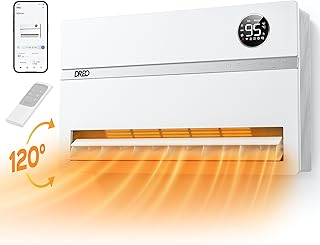
This wall-mounted unit provides widespread warmth with 120° oscillation and smart control via app, voice assistants, and remote. It’s designed for bedrooms or zones that require consistent heat and convenient scheduling. Best for: users who want easy, hands-free control and uniform heat distribution. Caution: ensure proper clearance for mounting and airflow direction to avoid blocked heat paths.
DREO Smart Electric Wall Heater

This wall heater emphasizes quiet operation at 28 dB with ECO mode and precise temperature control via app or remote. It features 11.5 ft/s airflow for efficient warmth and a 30° manual oscillation. Best for: basements that require a quiet, controllable heat source with energy-conscious operation. Limitation: may be less ideal for very large open plans without supplementary heating.
12000 BTU Mini Split Inverter System

This ductless mini split provides true zone climate control with 12000 BTU of cooling and heating, suitable for 550–750 sq. ft. The 19 SEER2 inverter helps energy efficiency, and the system supports WiFi app, Alexa, and remote control. Best for: basements that require consistent, whole-room climate with smart connectivity. Caution: installation requires professional mounting and a compatible interior layout.
Comfort Zone Ceiling Mounted Garage Heater

This 5000W ceiling-mounted heater is designed for spaces with limited floor space and uses a hard-wired installation. It distributes heat via louvers and adjustable mounting angle, ideal for garages or basements with exposed ceilings. Best for: basements used as workshops or storage where floor space is at a premium. Limitation: ceiling installation may require professional wiring and clearance planning.
Buying Guide
- What room size and layout do you need to heat? For large, open basements, consider multi-zone options or a mini-split for even distribution.
- Do you want portable flexibility or fixed installation? Portable infrared units offer easy relocation, while wall-mounted and ceiling models provide permanent heat without clutter.
- Which control methods matter? Apps and voice control add convenience, but require compatibility with your devices.
- Is quiet operation important? If the basement doubles as a living space or workspace, prioritize low-noise models (under 30 dB where possible).
- What is your budget and energy goal? Inverter systems and ECO modes can reduce operating costs over time.
FAQ
- What is the difference between a ductless heater and a typical space heater? A ductless heater, including wall-mounted and mini-split options, distributes heat more evenly and integrates into a room’s design, while portable space heaters are more flexible but may create hotspots.
- Can these units heat an entire basement? Many models are rated for large rooms or specific square-foot ranges; a mini split or multiple heaters are often best for whole-basement warmth.
- Are smart features worth it for basements? Yes, for scheduling, remote access, and voice control, especially if the basement is used irregularly or as a workspace.
- What maintenance do these require? Regular cleaning of air intakes, checking filters (if applicable), and inspecting wiring or mounting for fixed units are standard.
- Do I need professional installation? Wall- and ceiling-mounted or mini-split systems typically require professional installation to ensure safety and efficiency.