
In this guide
Your best options for ducted heating duct supplies are the five products below, chosen for a mix of reliability, ease of use, and suitability across common home HVAC projects. This guide helps homeowners, DIYers, and light-maintenance technicians decide which tape, wrap, or duct lining products fit their needs. Each item is evaluated for best use case, potential limitations, and practical installation notes.
| Product | Best For | Why It Stands Out |
|---|---|---|
| Romeda Aluminum Foil Tape | General duct sealing and dryer vents | 3.9 mil thickness offers balance between durability and conformability; strong adhesion at varying temperatures. |
| Frost King CF55 Foil Backed Duct Wrap | Insulation and vibration reduction | Foil-backed wrap with cushioned support and fire-rated safety for ducts. |
| Aluminum Foil Duct Tape Heavy Duty (SmaringWing) | Heavy-duty sealing and patching | High-temperature tolerance and versatile adhesion for repair and weatherproofing. |
| 4 Inch R4.2 Insulated Flexible Duct | New duct runs and retrofits | High-density insulation minimizes heat loss and cold air penetration. |
| 6 Inch R4.2 Insulated Flexible Duct | Longer runs and broader airflow | Same insulation benefits as 4-inch with larger diameter for greater airflow. |
Romeda Aluminum Foil Tape, 2″ x 65′ — Best All-Around Duct Tape
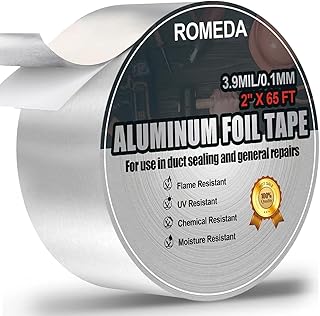
Best for: Quick-seal jobs on ducts and dryer vents. This tape features a 3.9 mil foil with a premium pressure-sensitive adhesive that remains sticky in both high and low temperatures. It is suitable for long-term temperature exposure up to 120°C and short-term up to 130°C.
Why selected: The moderate thickness reduces breakage risk while still conforming to curved duct surfaces. It resists UV and moisture and is designed to tear cleanly for fast installations, saving time on repairs or retrofits.
Caution: Ensure a clean, dry surface before applying; failure to prepare the surface can reduce adhesion. While durable, heavy-duty HVAC tapes should not replace mechanical fasteners in high-stress joints.
Frost King CF55 Foil Backed Duct Wrap

Best for: Insulating ducts to cushion vibrations and reduce noise. The wrap style adds a protective layer that contributes to safer handling and more stable temperature maintenance.
Why selected: Its foil-backed design offers a practical balance of cushioning and insulation for heating and cooling ducts. It’s a good option when both insulation and vibration dampening are priorities in living spaces.
Caution: Not a substitute for structural duct sealing in all configurations; use with appropriate tape or fasteners where necessary.
Aluminum Foil Duct Tape Heavy Duty Waterproof — 2″ x 65′ (3.9mil)

Best for: Durable sealing and patching on metal ducts and joints. This tape emphasizes waterproof performance and strong adhesion in various weather conditions.
Why selected: It uses a 3.9 mil thick foil with a robust adhesive, aiming to provide reliable seals without excessive thickness that complicates application. It’s suitable for both indoor and outdoor duct projects where moisture is a concern.
Caution: While highly versatile, avoid relying on tape alone for structurally critical joints in certain high-pressure ducts; verify if additional fasteners or sealants are recommended for your system.
4 Inch R4.2 Insulated Flexible Duct

Best for: New duct runs or retrofits where space is tight but insulation is essential to minimize energy loss. The R4.2 insulation helps reduce heat transfer and maintains HVAC efficiency.
Why selected: High-density insulation and a weather-resistant outer layer make it suitable for outdoor installations and damp environments like garages or basements. It’s easy to cut and bend to fit standard 4-inch ducting without specialized tools.
Limitation: Check local code requirements for insulation thickness and duct materials, especially in conditioned living spaces where moisture control is critical.
6 Inch R4.2 Insulated Flexible Duct
Best for: Larger diameter runs where airflow volume is a priority. The 6-inch option supports greater air throughput while still offering energy-efficient insulation.
Why selected: Shares the same insulation benefits as the 4-inch variant, with expanded diameter to accommodate different system layouts. The flexible design facilitates installation in constrained spaces like attics and crawl spaces.
Caution: Larger ducts may require more careful sealing at joints to prevent leaks; pairing with appropriate tape and seals is recommended for optimal performance.
Buying Guide
What should you consider when choosing duct supplies?
- Material and thickness: Thicker foil tapes resist tearing but can be harder to fit on curved surfaces. Balance with duct shape and temperature exposure.
- Temperature range: Select products rated for sustained high temperatures and occasional spikes typical of HVAC systems.
- Moisture and UV resistance: Outdoor or unconditioned spaces benefit from moisture-resistant and UV-stable tapes and wraps.
- Application surface: Smooth metal, fiberglass, and plastic joints may require different adhesives or backing; prep surfaces for best adhesion.
- Insulation needs: For energy efficiency, pair sealing tapes with insulated ducts to minimize heat loss and condensation.
- Ease of installation: Look for products with easy-tear edges, flexible conformability, and minimal residue after removal if needed.
Practical tips
- Keep surfaces clean and dry before applying tapes or wraps.
- Test fit and plan a single-pass application to avoid wrinkles and air pockets.
- For long runs, use a combination approach: foil tape for joints plus insulation wraps where applicable.
FAQ
- What is the best tape thickness for ducts? – A 3.9 mil (0.1 mm) foil tape offers a balance of durability and ease of use for most duct joints.
- Can foil tape be used outdoors? – Yes, if it is rated for moisture and UV exposure; ensure the surface is clean and dry before applying.
- Is insulation necessary with duct tape? – Insulation helps reduce heat loss and condensation; pairing insulated ducts with proper tape improves overall efficiency.
- How do I remove duct tape without residue? – Look for tapes designed to tear cleanly from edges and non-residue formulas; slow, steady pulling helps minimize residue.
- What if I have a large-diameter duct? – Use appropriately sized insulated ducts (like the 6-inch option) and ensure seals at joints are airtight with compatible tapes.