
In this guide
Keeping walkways clear of snow and ice is essential for safety and accessibility. This guide highlights top-rated driveway heating mats that provide reliable, energy-efficient snow and ice removal. Each option covers common sizes, installation ease, and performance to help you choose the right solution for your home. Below is a quick summary of five strong picks across different sizes and brands.
| Product | Brand | Size | Key Benefit |
|---|---|---|---|
| HeatTrak Heated Snow Melting Mats (30” x 60”) | HeatTrak | 30” x 60” | Durable, energy-efficient snow melt for walkways and entrances |
| HeatTrak Heated Snow Melting Mats (30” x 48”) | HeatTrak | 30” x 48” | Easy installation, reliable winter protection for entrances |
| WarmlyYours 3×15 ft. PowerMat | WarmlyYours | 3×15 ft | Under-asphalt/concrete installation for expanded coverage |
| Toriexon 30 x 48 inch Snow Melting Mats | Toriexon | 30” x 48” | UL/ETL-certified, solid melt rate with included power cord |
| Toriexon 20 x 60 inch Snow Melting Mats | Toriexon | 20” x 60” | Compact option with steady melt performance |
HeatTrak Heated Snow Melting Mats (30” x 60”)

HeatTrak mats are designed to withstand harsh winter conditions with a durable, corrosion-resistant surface suitable for continuous outdoor use. They are relatively simple to install and maintain, making winter prep straightforward. The mats melt snow at about 2 inches per hour and operate with energy efficiency that surpasses traditional systems. Surface temperatures rise to about 40 degrees Fahrenheit above ambient, functioning effectively down to -8 degrees Fahrenheit. This model is well-suited for long walkways or entryways that endure frequent snow events.
HeatTrak Heated Snow Melting Mats (30” x 48”)

This slightly smaller HeatTrak model shares the same durable construction and installation simplicity. It provides efficient snow melting for residential entrances and narrow walkways, delivering dependable performance with a similar energy profile to larger mats. Ideal for homeowners needing targeted protection at the door or a narrower path to the driveway, while maintaining low maintenance requirements.
WarmlyYours 3×15 ft. PowerMat
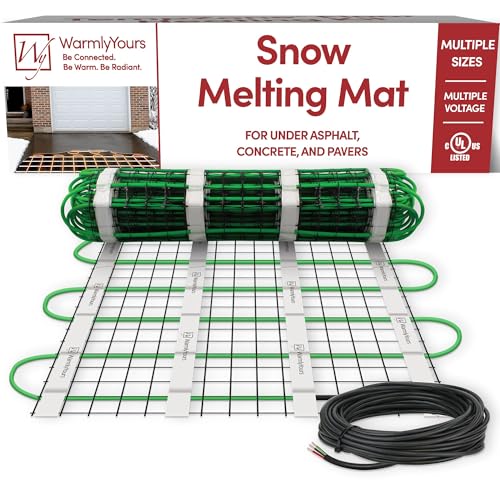
WarmlyYours PowerMat offers embedded installation under asphalt, concrete, or pavers, enabling a seamless appearance while providing robust snow and ice removal. The system is CSA certified and uses a twin-conductor heating cable to handle heavy winter use. It can be configured for full-coverage or targeted deicing, offering flexibility for larger driveways or interconnected walkways. The PowerMat line emphasizes reliability and long-term durability in challenging conditions.
Toriexon 30 x 48 inch Snow Melting Mats

These mats provide a solid balance of size, power, and certification. Each package includes a UL/ETL-certified power cord for safety compliance and consistent performance. The 2-inch-per-hour melt rate helps clear driveways and entryways efficiently, with a construction suited for wet, cold environments. They’re a practical choice for mid-size pathways and stairs where reliable melt is needed without a full-scale installation.
Toriexon 20 x 60 inch Snow Melting Mats

This slimmer Toriexon configuration provides a strong, efficient melt rate at 2 inches per hour, with UL/ETL-certified power components. Its 20” by 60” footprint makes it suitable for mid-width walkways or narrower drive approaches, offering straightforward installation and reliable winter performance in homes with limited space.
Buying Guide: Key Considerations For Choosing Driveway Heating Mats
- Size and coverage: Determine the area to be heated and whether you need full-coverage mats or targeted sections (e.g., entryways, stairs, or tire tracks).
- Power and compatibility: Check voltage requirements (110V–120V typical for residential use), wattage per square foot, and whether your electrical panel can support the load. Look for UL/ETL certification for safety.
- Installation approach: Decide between surface mats for above-ground placement and embedded mats designed to go under concrete, asphalt, or pavers. Embedded options are less visible but require professional installation.
- Durability and weather resistance: Choose corrosion-resistant materials and waterproofing ratings (IP ratings) to endure snow, rain, and freezing conditions while remaining safe for outdoor use.
- Energy efficiency and melt rate: Compare stated melting rates (e.g., inches per hour) and surface temperature behavior. Higher efficiency reduces operating costs while maintaining effective melt.
- Maintenance and safety features: Look for anti-slip surfaces, integrated leakage protection, and user-friendly test functions to verify operation. Ensure cords and plugs are weather-sealed to prevent water intrusion.
- Scalability and future-proofing: If you anticipate expanding coverage, choose mats that can be joined or paired with additional mats for seamless large-area heating.
- Brand support and warranty: Prefer brands with established track records, responsive customer support, and comprehensive warranties for outdoor electrical products.
- Aesthetics and installation disruption: Consider how visible the mats will be and whether you can integrate them with existing walkways or drive surfaces without extensive demolition.