
If you’re looking to spread warm air more evenly from a wood stove, a heat-powered stove fan can be a smart, energy-free solution. These devices require no electricity or batteries and start circulating once the stove reaches a certain temperature. They’re best for homeowners who want faster room warming, reduce hot spots, and maximize the heat from their stove. Below are five top options, chosen for reliability, performance, and practical use in American homes.
| Product | Best For |
|---|---|
| JossaColar Wood Stove Fan | Stoves without power connections; simple setup |
| Tomersun Wood Stove Fan (6 blades) | Higher airflow with aggressive heat distribution |
| Wood Stove Fan Dual Motor | Quiet operation and steady airflow |
| Tomersun Wood Stove Fan (8 blades) | Maximum heat dispersion and universal fit |
| VODA Wood Stove Fan | Affordable option with solid diffusion |
JossaColar Wood Stove Fan

Best for: Wood-burning stoves or log burners with a need for a straightforward, heat-activated fan. This model runs without batteries, powered solely by stove heat, making it a reliable accessory for off-grid or energy-conscious homes.
What to know: It includes a magnetic thermometer for temperature monitoring and a 1-year warranty with a 30-day refund option. The upgraded aluminum blade design helps spread heat more evenly around the room, and the compact size (6.5 inches long, 7.7 inches high) fits most stove tops.
Caution: Performance depends on stove heat; very low stove temperatures may delay start-up or reduce airflow.
Tomersun Wood Stove Fan (6 Blades)

Best for: Rooms where faster air movement matters. The 6-blade design delivers more air volume than typical 4-blade models, helping distribute warmth efficiently from wood, coal, or pellet-burning fireplaces.
What to know: No batteries or electricity required. The data notes potential fuel savings from improved circulation, though actual results vary by stove model and room layout.
Caution: Temperature range guidance should be followed; overexposure to very high stove temperatures can risk wear on components over time. Monitor with the included or compatible thermometer.
Wood Stove Fan Dual Motor

Best for: Quietly operating spaces where minimal noise is essential. The dual-motor design increases airflow while maintaining low sound levels.
What to know: The unit includes a temperature-sensing module to lift the fan away from overheated surfaces when temperatures rise, protecting the mechanism. A built-in thermometer helps track room safety and performance.
Caution: Higher airflow models can feel warmer in the immediate vicinity; position the fan away from direct skin contact when hot.
Tomersun Wood Stove Fan (8 Blades)

Best for: Large rooms or stoves with substantial heat output where maximum heat distribution is desired. The eight-blade design increases air movement and room coverage.
What to know: Includes a bracket for secure mounting on compatible stoves, plus a built-in thermometer and safety features to prevent overheating. Suitable for a wide range of flat-top stoves and fireplaces.
Caution: The higher blade count may require careful positioning on smaller stoves to avoid contact with nearby objects.
VODA Wood Stove Fan
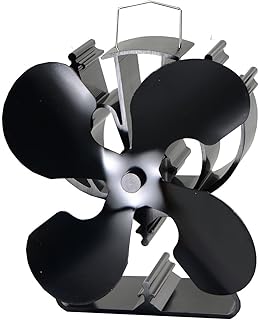
Best for: Budget-conscious buyers seeking reliable heat diffusion without extra features. This model provides solid performance at an accessible price point.
What to know: It promotes hot air diffusion and claims a 28% reduction in wood consumption through improved circulation. Performance will depend on stove heat and room layout.
Caution: While effective, it may not move as much air as higher-end models in very large spaces; pair with appropriate stove heat levels for best results.
Buying Guide
Key considerations when choosing a heat-powered stove fan:
- Heat activation: Most units start around 100–140°F. Check the exact activation temperature and ensure it matches your stove’s typical heat output.
- Airflow and blade design: More blades generally mean more air, but ensure your stove surface can accommodate the device without crowding.
- Noise and build quality: Look for models advertised as quiet (low dB) and with durable materials like aluminum blades and steel housings.
- Compatibility: Ensure the fan fits your stove type (flat-top, rounded top, or specific dimensions) and comes with mounting options if needed (brackets or magnets).
- Safety features: A thermometer or temperature-sensing mechanism helps prevent overheating. Some designs lift the fan away from hot surfaces to avoid damage.
- Maintenance: Simple cleaning and sturdy construction extend life. Consider users that are easy to disassemble for maintenance.
Frequently Asked Questions
- Do heat-powered stove fans require batteries?
No. They rely on the heat from the stove to operate, so no external power is needed. - Can a stove fan save energy or reduce fuel usage?
Some models claim reduced fuel consumption by improving heat circulation; actual savings depend on stove efficiency and room size. - Will a stove fan work on any stove?
Most flat-top or compatible wood-burning stoves work, but check dimensions and activation temperature to ensure compatibility. - Is there a risk of overheating a stove fan?
Many models include safety features like thermometers or lift mechanisms to avoid overheating; follow manufacturer guidelines. - How should I position a stove fan for best results?
Place the fan on the stove’s top surface where heat concentrates, or follow bracket/mounting instructions to maximize dispersion without obstruction. - Do multi-blade fans really move more air?
In many cases, yes; more blades can increase air displacement, but effectiveness also depends on motor design and stove heat.