
In this guide
Answering the question plainly: on-demand (tankless) water heaters can be better for many homes when space, energy efficiency, and continuous hot water are priorities. This guide compares five popular models to help you decide who benefits most—from apartment dwellers and compact kitchens to whole-home setups. The top picks here emphasize compact design, reliable performance, and clear temperature control. The included table summarizes each option’s strengths at a glance.
| Product | Best For | Key Benefit |
|---|---|---|
| 110V Tankless Electric (B0FTCMVRY3) | Small spaces, apartments | Compact, instant hot water, LED display |
| 14kW Orbek Tankless (B0FRFJVG8L) | 2-3 point use, kitchens/bathrooms | High flow, energy efficiency |
| 14kW Tankless 240V (B0F9NPTK5F) | Under-sink or on-wall installs | Space-saving, strong performance |
| MIZUDO Gas Tankless (B0GDF9QT35) | Whole-house, multiple outlets | High GPM, precise temp control |
| 18kW Electric Tankless (B0DLKQY4B3) | Shower-heavy homes, 2–3 bathrooms | Continuous hot water, energy self-modulation |
110V Tankless Electric With Digital Display
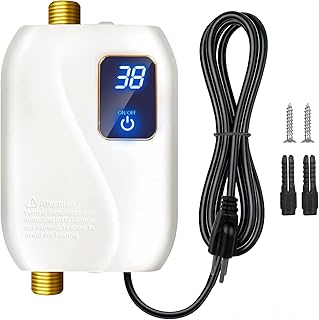
This 110-volt tankless water heater uses stainless steel and ABS materials with a 3000W power rating. It delivers quick hot water gains (82°F at 0.3 GPM, 131°F at 0.5 GPM) and features a clear LCD display. It supports Fahrenheit or Celsius degrees with a six-second hold—no preheating delay. IPX4 waterproofing and automatic shutoff under overheating provide safety. Best for apartments, small kitchens, or under-sink installations where space and simple operation matter. Caution: It is designed for specific flow rates; very high simultaneous demand may reduce water temperature.
Best for: Compact spaces, single-point usage like under-sink or small kitchen/bath setups.
14kW Orbek Tankless Water Heater (240V)

Orbek’s 14kW 240V tankless water heater delivers up to 3.38 GPM for hot water on demand. It requires a robust electrical setup (150+ amps total, 240V/60A two-pole breaker, 6 AWG wiring) and standard 1/2″ NPT water connections. This unit is well-suited for 2–3 fixture points (bathroom and kitchen) and emphasizes cost savings through on-demand heating. Limitations include the need for a suitable electrical panel and professional installation. Best for: homes with heavy daily use across multiple fixtures where a dedicated 14kW unit fits the panel capacity.
14kW Tankless 240V, Sink & Shower
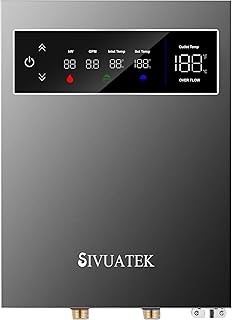
This model provides up to 99.8% thermal efficiency with 14kW heating power. It enables instant hot water for 1–2 simultaneous points, such as a kitchen and a bathroom. Installation notes include a required 60-amp circuit and standard 1/2″ NPT connections. It is compact and designed for under-sink or on-wall mounting. Choose this if you need reliable, rapid hot water without a large tank. Limitation: potential high electrical load may require panel upgrades.
MIZUDO Gas Tankless Water Heater, 199k BTU

With 199,000 BTU and a 10.3 GPM capability, this gas-powered unit supports whole-house hot water for multiple outlets. It offers ±1°F temperature stability and a wide adjustable range up to 149°F. It is particularly suitable for homes needing consistent temperature across two to three bathrooms and kitchens. Caution: gas installation requires proper venting and professional service, and venting compliance should be verified before purchase.
18kW Electric Tankless Water Heater (WiFi)

Rated at 18kW (75A max), this unit requires 2 x 40A DP breakers and 2 x 8/2 AWG wiring. It features self-modulating energy use, stabilizing water temperature and delivering up to 4.3 GPM. It’s designed for residential showers and everyday use without preheating. Best for homes with two to three bathrooms seeking reliable, continuous hot water. Note: installation should be done by a qualified electrician due to high amperage requirements.
Buying Guide: Key Considerations for On-Demand Water Heaters
- Household size and hot water demand: For single fixtures or compact spaces, a 110V or low-watt density unit may suffice. For whole-house needs, consider higher kW or gas models.
- Electrical / gas capacity: Electric models require sufficient circuit capacity and appropriate breakers. Gas models rely on venting and gas line compatibility.
- Flow rate and temperature: Look for GPM ratings and adjustable temperature ranges to ensure comfort at peak usage times.
- Space and installation: Under-sink, wall-mounted, or compact floor-space options are ideal for tight layouts. Gas units require venting considerations.
- Energy efficiency and operating costs: Self-modulating or on-demand systems reduce standby losses; compare energy usage at typical flow rates.
- Safety features: Water-electrical isolation, dry-boil protection, anti-freeze or frost protection, and automatic shutoff enhance safety in wet environments.
- Maintenance and durability: Stainless steel or corrosion-resistant components extend lifespan in hard-water areas. Consider filter or descaling needs.
Frequently Asked Questions
- Are on-demand water heaters more energy-efficient than traditional tanks?
Yes, because they heat water only when needed, reducing standby heat loss. The degree of savings depends on usage patterns and water flow. - Can I install an on-demand heater in a small apartment?
Yes, there are compact 110V and 240V models designed for apartments and under-sink installations. - What type of maintenance does an on-demand heater require?
Periodic descaling or filter checks may be needed in hard-water areas; follow manufacturer maintenance guidelines. - Do on-demand heaters provide hot water at the same temperature for multiple fixtures?
Some models offer high GPM and stable temperature control, but water temperature can drop if multiple fixtures demand peak flow beyond the unit’s capacity. - Is gas or electric better for whole-house use?
Gas units generally offer higher flow for large homes, while electric units are simpler to install but may require larger electrical service upgrades. - Do on-demand heaters require professional installation?
For gas models, venting and gas hookups require licensed technicians; electrical installations should follow local codes and often require a qualified electrician.