
Answering your search for a high-capacity propane heater, these models are among the best options for large spaces, garages, and work sites. They offer high BTU output, durable construction, and features that improve safety and ease of use. This guide highlights five near-top choices most relevant to 175,000 BTU ranges, explaining who each is best for and why. It also includes a practical buying guide and a brief FAQ to help you compare quickly.
| Product | Best For | Approx. BTU | Notes |
|---|---|---|---|
| Reznor 175K BTU Propane Garage Heater | Commercial garages and workshops | 175,000 | Ceiling-mount or wall-mount capable with proper brackets |
| Mr. Heater Original 540-Degree Radiant 45,000 BTU | Portable warmth for outdoor or smaller spaces | 45,000 | Tank-top radiant design; portable |
| Mr. Heater 170,000 BTU Quiet Burner Tech Heater | Large sheds and medium-to-large spaces | 170,000 | Thermostat control and long runtime |
| Reddy Heater 150,000 BTU Forced Air | Large garages and outdoor work areas | 120,000–150,000 | Durable low-pressure system; CSA certified |
| Anrain 150,000 BTU Forced Air | Heavy-duty job sites and long operation | 120,000–150,000 | Extended hose and regulator included |
Reznor 175K BTU Propane Garage Heater

The Reznor UDXC-175 is a high-capacity propane heater designed for indoor use in garages, workshops, and similar spaces. Best for commercial or industrial environments that require consistent heat output. It is rated for 175,000 BTU with an 83% thermal efficiency and includes mounting options for ceiling or wall installation (mounting brackets sold separately). This model is suited for spaces where a reliable, high-BTU heater is needed to maintain steady temperatures during cold months.
Best for: large garages and workshops that need robust, continuous heat. Choose this if you require industrial-grade output and the option to suspend the unit for optimal air distribution. Limitation: installation may require additional mounting hardware and appropriate ventilation planning.
Mr. Heater Original 540‑Degree Radiant Propane Heater

This unit is a portable radiant heater that mounts directly to a 20 lb propane tank. It offers two primary settings (high, medium, and low) for 45,000–30,000 BTU output and includes a tip-over safety shut-off. It’s best for individuals needing quick, localized warmth in outdoor work areas, patios, or tents where portability matters. Caution: not ideal for large enclosed spaces due to lower BTU output compared to industrial models.
Mr. Heater 170,000 BTU Quiet Burner Propane Heater

This forced-air heater delivers up to 170,000 BTU and can warm spaces up to about 4,250 sq. ft. It works with standard 100 lb propane tanks and provides long operation times—up to 17 hours on a full tank. Best for large garages or open workshop areas that require strong, even heat. Caution: ensure adequate ventilation to manage fuel combustion byproducts in enclosed spaces.
Reddy Heater 150,000 BTU Forced Air
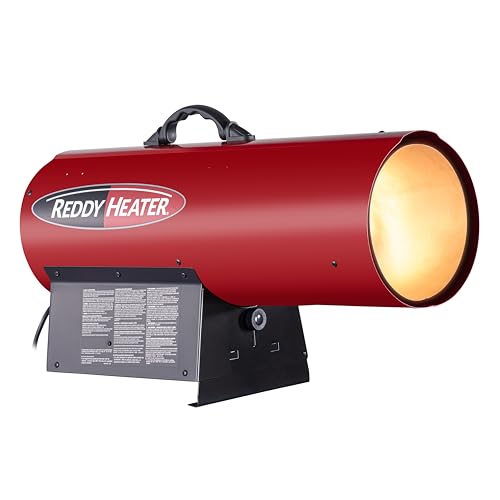
Manufactured as a heavy-duty, low-pressure forced-air unit, the Reddy Heater RFG150V outputs 120,000–150,000 BTU and is suited for large garages, workshops, and construction sites. It emphasizes durability and reliable performance in outdoor conditions thanks to CSA certification. Best for: environments needing high heat with rugged construction. Limitation: slightly higher fuel consumption at maximum output and may require a larger fuel supply line for continuous operation.
Anrain 150,000 BTU Forced Air Propane Heater

This Anrain forced-air heater supports 120,000–150,000 BTU with adjustable low/medium/high settings and includes an 11-foot hose and regulator for convenient connection to a propane tank. It’s suitable for large spaces and job sites that demand dependable heat distribution. Best for: long-duration heating where a flexible fuel connection is advantageous. Caution: ensure safe clearance and proper venting in enclosed areas.
Buying Guide: High-Capacity Propane Heaters For Big Spaces
What space size should you target? For engines of up to about 4,500 sq. ft., consider units around 150,000–170,000 BTU. For larger industrial spaces, 175,000 BTU or more may be necessary. What installation style fits your space? Ceiling or wall mounting can save floor space, while portable models are easier to move. Do you need continuous operation? Look for units with long runtimes on standard propane tanks and consider hose length and regulator compatibility. How important is safety? Check for tip-over switches, auto shut-off features, and CSA or other safety certifications. Do you need thermostat control? Some models offer built-in thermostats to maintain steady temperatures. Ventilation is crucial; ensure the space has adequate ventilation to manage combustion byproducts. Finally, confirm compatibility with standard propane tanks (20 lb vs. 100 lb) and required clearances from combustibles.
Key Buy-Alerts
- High-BTU units are best for large, open spaces but may consume fuel quickly.
- Wall or ceiling mounting can free up floor space and improve heat distribution.
- Always verify proper ventilation and clearance requirements before operation.
- CSA or other safety certifications indicate adherence to safety standards for propane heaters.
FAQ
- What size space is ideal for 170,000 BTU heaters? Typically large garages or warehouses up to several thousand square feet, depending on insulation and ceiling height.
- Do these heaters require electricity? Some models are fully propane-powered with piezo ignition; others may require electricity for fans or thermostats. Check each model’s features.
- Can I mount any 175,000 BTU heater on the ceiling? Mounting requires compatible brackets and hardware; consult installation guidelines for weight and clearance.
- Is CSA certification important? Yes, CSA-certified units have undergone safety testing and meet recognized standards for propane appliances.
- What fuel considerations exist? Most listed models use standard 20 lb tanks, but some require or pair better with larger tanks or additional hoses/regulators.
- Are there safety features I should look for besides a tip-over switch? Automatic shut-off on flame failure, overheat protection, and oxygen depletion sensors enhance safety in operation.