
In this guide
Finding the right 170,000 BTU propane heater means balancing power, noise, safety, and run-time for your space. This guide highlights five top options and who they’re best for, from large work sites to garage workshops. Each product section notes who benefits most, plus practical caveats. The buying guide toward the end helps you compare features like noise levels, fuel compatibility, and safety protections so you can choose with confidence.
Summary of chosen products for quick comparison:
- Mr. Heater 170,000 BTU Quiet Burner Technology Forced Air Propane Heater with Thermostat – Best for large spaces and extended operation with standard 100 lb tanks.
- DEWALT 150,000 BTU Forced Air Propane Quiet Burner Technology Job Site Heater – Best for quieter operation and rugged job sites.
- FOGATTI Tankless Water Heater Gas Propane Indoor On Demand CSA Certified – Best for compact spaces needing continuous hot water and high BTU capacity.
- ThermoMate 18,000 BTU Propane Heater – Best for controlled, smaller work areas or multi-use spaces with safety features.
- DEWALT 68,000 BTU/H 1,700 sq ft Forced Air Propane Heater – Best for medium-sized spaces and lower operating costs.
Mr. Heater 170,000 BTU Quiet Burner Propane Heater
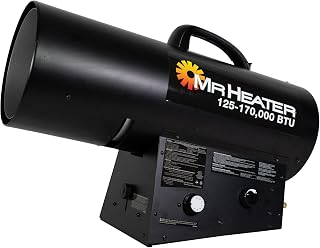
Best for: Large spaces like workshops or barns where consistent heat is essential. Why selected: It delivers up to 4,250 sq ft of warming capacity and long runtime on a full tank, making it suitable for extended use in open-floor plans. The built-in thermostat helps maintain a steady temperature. Consider this if you rely on standard 100 lb propane tanks and need a dependable, high-output model.
Limitation: Requires appropriate ventilation for a compliant indoor installation and does not specify integrated safety shutoffs beyond standard protections in the unit family.
DEWALT 150,000 BTU Propane Heater With Quiet Burner

Best for: Job sites needing quieter operation and durable construction. Why selected: Quiet Burner Technology reduces noise by up to 50 percent, which helps comfort during long shifts. Recessed controls reduce damage risk on rugged sites, and the two-piece barrel design aids maintenance. Choose this if noise reduction and easier upkeep are priorities on-site.
Limitation: Slightly less heating capacity than the top 170k models, so larger uninterrupted areas may require more units or supplementary heat.
FOGATTI Tankless Water Heater Gas Propane Indoor On Demand

Best for: Spaces needing on-demand hot water along with substantial heating power. Why selected: It delivers a high 170,000 BTU input and a 7.5 GPM flow rate, with compact space requirements. This model is ideal for multitasking households or workspaces that require both heat and hot water. The four-stage combustion and temperature precision help maintain comfort and efficiency.
Limitation: This is a water heater with integrated heat capabilities; suitability depends on whether your application prioritizes hot water alongside space heating.
ThermoMate 18,000 BTU Propane Heater

Best for: Smaller, versatile spaces needing radiant heat with safety features. Why selected: This unit delivers 18,000 BTU of radiant warmth and can operate for extensive hours on a modest propane supply. It includes ODS safety and tip-over protection, making it a sensible choice for garages, workshops, or patios where space management and safety matter.
Limitation: Lower BTU output means it is not ideal for very large open areas or spaces that require rapid heating to a high setpoint.
DEWALT 68,000 BTU/H Propane Heater

Best for: Medium-sized spaces where efficiency and cost-conscious operation are priorities. Why selected: With 68,000 BTU per hour, this unit offers solid performance at a more moderate heat output, which can be suitable for rooms that don’t require maximum power. It provides a straightforward option for those balancing heat needs with budget considerations.
Limitation: Notably lower BTU rating means slower warmups in very large areas; pairing with another heater may be necessary for maximum coverage.
Buying Guide
- Space size and heat demand: Larger spaces benefit from higher BTU ratings or multiple units. For spaces over 2,000–3,000 sq ft, plan for at least one 150k–170k BTU unit or multiple units with strategic placement.
- Fuel source and tank type: Standard 100 lb tanks are common for high-output units. Check availability and refill logistics in your area.
- Ventilation and safety: Indoor use requires proper ventilation and adherence to safety features such as oxygen depletion sensors (ODS), tip-over protection, and automatic shutoffs where applicable.
- Noise and site impact: Quiet burner technology can significantly reduce operator fatigue on jobsites. Consider recessed controls and rugged construction for durability.
- Durability and maintenance: Look for units with accessible service panels and simple cleaning procedures, especially on rugged job sites.
- Multi-function options: Tankless water heater combinations can offer space heating plus hot water, suitable for multifamily or heavy-use spaces.
- Operational considerations: Temperature control capabilities (thermostats), timing features, and automatic safety shutoffs improve consistent performance and safety.
Frequently Asked Questions
- What size space can a 170,000 BTU heater handle?
– It can heat large spaces like workshops, barns, and large garages, typically up to several thousand square feet depending on insulation and ventilation. - Do these heaters require special ventilation for indoor use?
– Yes, most high-BTU propane heaters require adequate ventilation to ensure safe operation and to avoid carbon monoxide buildup. - Is quieter operation possible with high-output heaters?
– Some models use Quiet Burner Technology to reduce noise, which is beneficial for longer work sessions. - Can I use a standard residential propane tank with these heaters?
– Many high-output units are designed for 100 lb or larger tanks. Verify tank compatibility in the product specs. - Are there safety features I should prioritize?
– Look for oxygen depletion sensors, tip-over protection, auto shutoff, and reinforced controls for durability on jobsites.