
Upgrade or replace your 120-volt inline thermostat with options designed for attic ventilation, space heating, cooling, or general temperature control. This guide highlights five reliable 120V thermostats, each suited to different setups, from attic fans to plug-in devices. Ideal for homeowners, DIY enthusiasts, and small workshop users seeking automatic temperature control without complex wiring.
| Product | Brand | Best For | Notes |
|---|---|---|---|
| TH5 Line Voltage Thermostat Assembly | Legacy | General 120V heating/cooling control with 3-prong cord | Simple plug-in, 15A capacity |
| Attic Fan Thermostat Control (58033) | Aibabcue | Attics, greenhouses, and exhaust fans | Adjustable 50°F-120°F; single speed |
| Attic Fan Temperature Controller (58033 Upgrade) | Hiorucet | Power ventilators and exhaust fans | 10A at 120V; 50°F-120°F range; caution on power disconnection |
| Diymore Digital Plug-in Thermostat Outlet | diymore | Heaters or coolers via outlet control | Multiple timer modes; ±1% accuracy |
| KETOTEK Digital Thermostat Outlet Plug | KETOTEK | Automated temperature control on outlets | 15A max; wide range; cycle/timer modes |
TH5 Line Voltage Thermostat Assembly

The TH5 Line Voltage Thermostat Assembly by Legacy is a 120 Volt, 15 Amp thermostat with a 3-prong US outlet. It supports heating or cooling configurations by adjusting wire terminals. Best for users seeking a straightforward, plug-in control solution for simple rooms or DIY projects that require reliable automatic temperature decisions without extensive wiring. Caution: ensure correct wiring before energizing the circuit.
Attic Fan Thermostat Control (58033) by Aibabcue

This thermostat switch is designed to regulate attic fans, offering adjustable control from 50°F to 120°F. It’s a practical substitute for an aging attic thermostat, helping maintain ventilation and energy efficiency. Best for homes with gable vents, cocklofts, greenhouses, or small factory spaces that require automatic on/off based on temperature. Limitation: single-speed operation means no multi-stage control.
Attic Fan Temperature Controller (Upgrade) by Hiorucet

The Hiorucet Attic Fan Temperature Controller provides precise 50°F-120°F regulation for 120V, 10A single-speed operation. It’s designed as a premium replacement for existing attic thermostats, suitable for power attic and exhaust fans. Best for upgrading older ventilation systems to improve automatic control and energy savings. Caution: disconnect power before servicing.
Diymore Digital Plug-in Thermostat Outlet
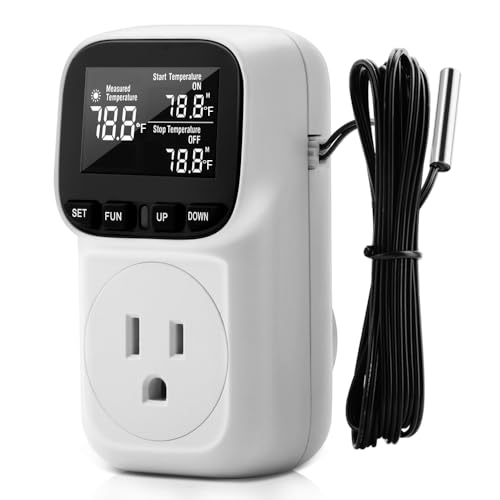
The Diymore Digital Plug-in Thermostat Outlet offers five temperature controller modes, including cycle timer and countdown functions. It supports precise control from -104°F to 210°F with Celsius/Fahrenheit display. Best for campers, small heaters, or cooling devices that need programmable on/off cycles. Note: some modes cannot be used concurrently.
KETOTEK Digital Thermostat Outlet Plug

The KETOTEK thermostat plug automatically switches between heating and cooling modes based on start/stop temperatures. It supports a wide range (-40°C to 120°C) with ±1°C/±2°F accuracy and offers timing modes (cycle or countdown). Best for spaces that require automated outlet control without hard-wiring. Limitation: timing and temperature functions cannot be used simultaneously.
Buying Guide
Key considerations help you choose the right 120V inline thermostat for your setup. Evaluate the environment, device load, and control needs before buying.
What is the capacity you need?
Most units listed support up to 10–15 amps at 120V. For larger fans or heaters, verify the maximum amperage and ensure the device load does not exceed the thermostat’s rating to avoid overheating or tripping breakers.
What temperature range fits your space?
Attic spaces often require higher setpoints or broader ranges. Look for a model with a 50°F–120°F (10°C–48.89°C) range or wider, to accommodate seasonal changes and different equipment.
Do you want plug-in convenience or wired installation?
Plug-in thermostats offer quick setup and are ideal for retrofits or temporary solutions. Hard-wired models suit permanent installations where aesthetics and safety are priorities.
Is single-speed acceptable or do you need multi-stage control?
Several options are single-speed, which is fine for basic control. If you require more nuanced operation, choose a model that supports multiple modes or adjustable cycling to optimize ventilation and energy use.
Are timing and scheduling features important?
Thermostat outlets with cycle timing or countdown modes provide automation without dedicated thermostats. Ensure you understand whether timing can be used with temperature control in the same setup.
What safety considerations apply?
Follow product cautions, such as disconnecting power before servicing and avoiding use beyond recommended environmental conditions. Ensure devices are installed in ventilated, dry spaces to prevent electrical hazards.
How should you compare products?
Compare based on: adjustable temperature range, amperage rating, compatibility with your devices, availability of cooling/heating modes, and whether the unit supports cycle or countdown timing. Use this information to identify the best match for a given attic, workshop, or room configuration.
FAQ
- What is a 120V inline thermostat used for? It controls a connected heater, cooler, or fan by turning the device on or off at a set temperature.
- Can I install these myself? Many plug-in models are designed for easy, do-it-yourself installation. If wiring is involved, follow the manufacturer’s instructions and local codes.
- What happens if the temperature sensor fails? Some models include resets or manual overrides. Check the product manual for troubleshooting options and safety guidance.
- Are these suitable for attic spaces? Yes, several models are designed specifically for attic fans and ventilators, with temperatures in the typical attic range.
- Do these devices support both heating and cooling? Some models switch between heating and cooling modes automatically based on the start/stop temperature settings.
- Do these thermostats require professional installation? Most plug-in versions do not, but hard-wired installations may require a licensed electrician, especially when dealing with high-load circuits.